
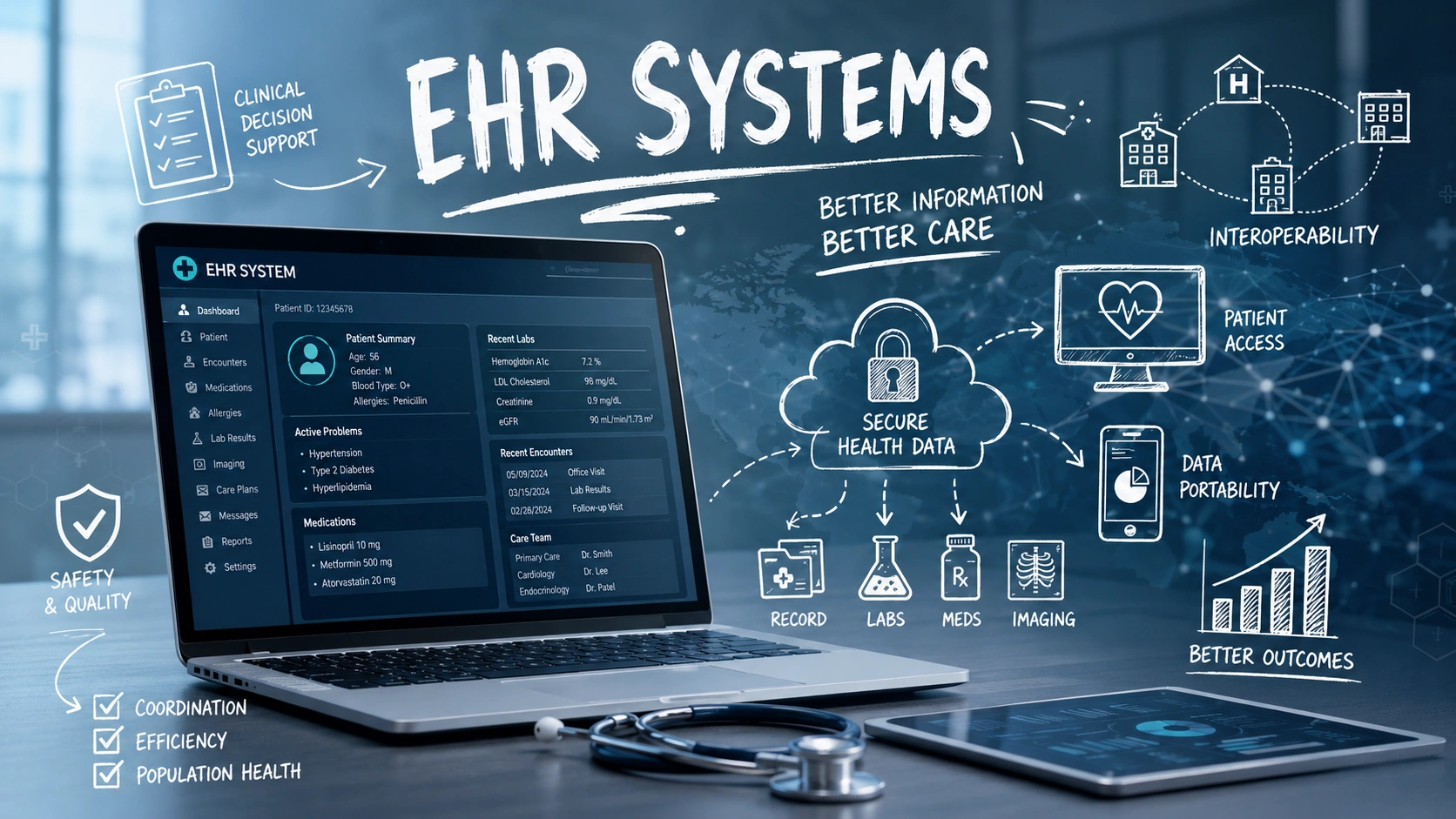
Electronic health records have become a central part of modern healthcare infrastructure. Instead of relying primarily on paper charts stored in individual offices or facilities, healthcare organizations can use EHR systems to document care, review clinical information, coordinate treatment, exchange health data, and give patients electronic access to parts of their records.
The potential benefits are substantial. Well-designed electronic health records can make relevant information easier to retrieve, support care coordination, reduce dependence on paper documentation, and provide tools for clinical decision support and quality measurement.
However, digitizing healthcare has not eliminated inefficiency. Poorly designed workflows, excessive documentation requirements, difficult interfaces, inbox overload, fragmented data exchange, cybersecurity risks, and alert fatigue can create new problems.
The central question is therefore no longer whether healthcare should use digital records. The more useful question is how EHR systems can deliver better information without increasing unnecessary work for clinicians or creating additional risks for patients.
The central question is therefore no longer whether healthcare should use digital records. The more useful question is how EHR systems can deliver better information without increasing unnecessary work for clinicians or creating additional risks for patients.
What Is an Electronic Health Record?
An electronic health record, or EHR, is a digital record of a patient’s health information that can be created and updated over time.
Depending on the healthcare organization and system, an EHR may contain information such as:
- diagnoses and health problems;
- medications;
- allergies;
- immunization history;
- laboratory results;
- radiology reports;
- vital signs;
- progress notes;
- treatment plans;
- procedures;
- medical and surgical history; and
- other information relevant to patient care.
Modern EHR systems do more than store clinical notes. They may also support electronic prescribing, medication reconciliation, laboratory ordering, results review, clinical alerts, quality reporting, billing workflows, referrals, secure messaging, and information exchange.
The value of an EHR depends not only on the amount of information it contains but also on whether clinicians and patients can access useful information when they need it.
EHR vs. EMR: What Is the Difference?
The terms electronic health record and electronic medical record are sometimes used interchangeably in everyday conversation, but they traditionally describe somewhat different concepts.
An electronic medical record (EMR) generally refers to a digital version of the clinical chart maintained within a particular practice or organization.
An electronic health record (EHR) has a broader concept. It is intended to support a more longitudinal view of a person’s health information and, when systems and policies permit, information exchange across different healthcare settings.
In practice, terminology is not always used consistently. Some products called EMRs have extensive information-sharing capabilities, while some EHR implementations still face significant interoperability barriers.
The more meaningful question is often not what the software is called, but whether it can securely capture, retrieve, exchange, and use health information across the patient’s care journey.
How EHR Systems Work
An EHR system serves as a digital environment for documenting and managing information generated during healthcare delivery.
A typical workflow may begin when a patient schedules an appointment or enters a healthcare facility. Administrative and clinical information can then be added or updated throughout the care process.
For example, an EHR may allow a clinician to:
- review the patient’s medical history and medication list;
- document symptoms and examination findings;
- order laboratory or imaging tests;
- prescribe medications electronically;
- review test results;
- receive clinical alerts;
- send referrals or care instructions;
- communicate with other members of the care team; and
- make selected information available to the patient electronically.
The exact capabilities differ between products, healthcare organizations, specialties, and countries.
What Are the Benefits of Electronic Health Records?
The benefits of EHR systems depend heavily on implementation quality, workflow design, staff training, interoperability, and system usability.
A poorly implemented system can create frustration and inefficiency. A well-designed implementation can support several important aspects of healthcare delivery.
Faster Access to Clinical Information
Paper records can be difficult to locate, retrieve, and share. Electronic records allow authorized users to retrieve information without physically locating a chart.
Immediate access can be particularly useful when clinicians need to review medication lists, allergies, previous test results, or other relevant clinical information.
This does not mean that every piece of information in an EHR is automatically accurate or useful. Data quality, reconciliation, and appropriate presentation remain essential.
Better Care Coordination
Patients often receive care from multiple clinicians and organizations.
When information can move securely between appropriate systems, healthcare professionals may have a more complete view of previous diagnoses, medications, tests, procedures, and treatment plans.
Better information exchange can support transitions between primary care, specialty care, hospitals, pharmacies, laboratories, and other services.
However, the existence of an electronic record does not guarantee interoperability. Systems must be technically capable of exchanging information, and the receiving organization must be able to incorporate and use that information effectively.
Clinical Decision Support
EHR systems can provide clinical decision support at the point of care.
Depending on the system, these tools may include:
- drug-allergy warnings;
- drug interaction alerts;
- preventive care reminders;
- dose-related alerts;
- guideline-based prompts;
- duplicate test warnings; and
- other decision-support interventions.
These tools can support safer and more consistent care, but they must be carefully designed. Too many low-value alerts can contribute to alert fatigue, making it more difficult for clinicians to identify the warnings that genuinely require attention.
Reduced Dependence on Paper Records
Electronic records reduce the need to store and transport large volumes of paper charts.
Digital systems can also make information easier to search, organize, and retrieve. However, digital records introduce different infrastructure requirements, including access controls, backup systems, cybersecurity protections, system maintenance, and downtime procedures.
The transition from paper to digital therefore changes the nature of record-management risks rather than eliminating them entirely.
Quality Measurement and Population Health
Structured EHR data can support quality measurement, clinical audits, public health reporting, and population health initiatives.
Healthcare organizations may use data to identify groups of patients who need preventive services, monitor selected quality measures, and evaluate patterns of care.
The usefulness of these functions depends on data quality. Incomplete, duplicated, incorrectly coded, or poorly standardized information can limit the reliability of analysis.
How EHRs Give Patients Access to Health Information
One of the major changes in digital healthcare is the growing ability of patients to access their own health information electronically.
Patient-facing tools may allow users to:
- review test results;
- read clinical notes;
- check medication lists;
- request prescription refills;
- schedule appointments;
- view after-visit summaries;
- download selected health information; and
- send secure messages.
In the United States, patient access increasingly extends beyond traditional web portals. Application programming interfaces, or APIs, can allow patients to use compatible applications to access standardized health information from participating healthcare organizations.
This shift is important because an EHR should not function only as an internal documentation system for healthcare organizations. Patient access and data portability have become central parts of modern health information policy.
What Is EHR Interoperability?
Interoperability is the ability of different information systems to exchange data and make that information available for appropriate use.
For healthcare, this can mean enabling information to move between hospitals, physician practices, laboratories, pharmacies, health information networks, patients, and other authorized participants.
Interoperability has several dimensions.
Technical interoperability concerns whether systems can connect and exchange data.
Semantic interoperability concerns whether the receiving system can interpret the meaning of exchanged data consistently.
Organizational and policy interoperability concerns governance, permissions, identity, workflow, trust, and legal requirements surrounding information exchange.
Standards such as HL7 FHIR have become increasingly important for API-based health data exchange. However, standards alone do not solve every problem. Real-world interoperability also depends on implementation consistency, data quality, organizational practices, and whether information fits naturally into clinical workflows.
EHR Systems and Information Blocking
Digital health information is most useful when authorized users can appropriately access, exchange, and use it.
In the United States, information blocking policy addresses certain practices that are likely to interfere with access, exchange, or use of electronic health information unless a regulatory exception applies.
This policy environment reflects a broader shift in health IT. The goal is not simply to digitize records within individual organizations, but to make appropriate health information more accessible across the healthcare ecosystem.
Interoperability remains a work in progress. Technical limitations, inconsistent implementation, workflow problems, governance issues, and data quality can still make information exchange difficult even when records are electronic.
The Disadvantages and Challenges of EHR Systems
EHR systems offer significant capabilities, but their limitations deserve equal attention.
The most common problems are not arguments for returning to paper records. They are design, workflow, governance, and implementation problems that healthcare organizations and technology developers need to address.
Documentation Burden
Documentation burden is one of the most persistent concerns associated with EHR use.
Clinicians may need to complete extensive documentation, respond to electronic messages, manage refill requests, review results, complete administrative tasks, and navigate complex interfaces.
Some documentation is clinically valuable and legally necessary. Other work may result from inefficient workflows, duplicative requirements, poor system configuration, or tasks that could be handled by other members of a care team.
The result can be substantial time spent interacting with the EHR rather than directly with patients.
Reducing this burden requires more than making clinicians type faster. Organizations may need to redesign workflows, simplify documentation expectations, improve team-based task distribution, optimize inbox routing, and remove unnecessary administrative work.
Poor Usability
An EHR can contain valuable information and still be difficult to use.
Usability problems may include:
- excessive clicking;
- confusing navigation;
- fragmented displays;
- important information buried in long notes;
- inconsistent interfaces;
- repetitive data entry;
- poorly prioritized alerts; and
- difficult inbox workflows.
Usability is a patient-safety issue as well as a productivity issue. Systems should make important information easier to find and interpret, not merely collect larger volumes of data.
Alert Fatigue
Clinical alerts can help prevent errors, but too many alerts can reduce their effectiveness.
When clinicians receive frequent low-value or irrelevant warnings, they may begin overriding alerts routinely. This creates the risk that an important warning will receive insufficient attention.
Effective decision support requires careful prioritization. Alerts should be clinically meaningful, appropriately timed, and designed for the actual workflow in which decisions occur.
Data Quality Problems
Electronic information is not automatically correct.
EHRs can contain:
- outdated medication lists;
- duplicate entries;
- incorrect diagnoses;
- copied-forward information;
- inconsistent coding;
- incomplete external records; and
- documentation that is technically extensive but clinically difficult to interpret.
Good data governance requires processes for reconciliation, correction, provenance, and quality improvement.
Implementation Costs and Organizational Disruption
Implementing or replacing an EHR system can be a major organizational project.
Costs may include software, hardware, interfaces, migration, training, cybersecurity, workflow redesign, maintenance, upgrades, and productivity changes during implementation.
Large-scale EHR modernization projects have demonstrated that technology implementation can encounter significant configuration, usability, data migration, and governance challenges.
The lesson is that purchasing software is only one part of EHR transformation. Successful implementation requires clinical leadership, user involvement, testing, training, workflow redesign, and continuous optimization.
EHR Privacy and Cybersecurity
Electronic health information is highly sensitive, making privacy and cybersecurity central concerns.
Healthcare organizations need safeguards appropriate to their systems and risks. These may include:
- identity and access management;
- role-based permissions;
- multifactor authentication;
- encryption;
- audit logging;
- network segmentation;
- security monitoring;
- vulnerability management;
- backup and recovery systems;
- incident response planning; and
- workforce training.
Cybersecurity is not only an information technology problem. A serious disruption can affect access to clinical information and healthcare operations.
Organizations also need procedures for periods when electronic systems are unavailable. Downtime planning should address how clinicians access essential information, document care, order medications or tests, and reconcile records after systems are restored.
EHRs, Predictive Algorithms, and Artificial Intelligence
The next stage of EHR development is increasingly connected to artificial intelligence and predictive decision support.
Potential applications include:
- automated clinical documentation;
- draft summaries;
- inbox message classification;
- information retrieval;
- risk prediction;
- identification of care gaps;
- coding assistance;
- clinical decision support; and
- administrative workflow automation.
These applications may reduce some forms of repetitive work, but they also introduce new questions.
An AI-generated summary can omit important information. A predictive model can perform differently across patient populations. Automation can create new errors if users place excessive trust in its output.
Healthcare organizations therefore need appropriate oversight, testing, monitoring, transparency, and human review when implementing algorithmic tools.
The goal should not be to add AI to every EHR function. It should be to use technology where it produces measurable improvements in safety, quality, access, or workflow.
What Makes an EHR System Effective?
An effective EHR is not simply the system with the longest feature list.
For healthcare organizations, important considerations include:
- usability;
- reliability;
- interoperability;
- cybersecurity;
- data portability;
- clinical workflow fit;
- specialty requirements;
- reporting capabilities;
- patient access;
- vendor support;
- implementation resources;
- training requirements;
- downtime procedures; and
- total cost of ownership.
Healthcare organizations should also evaluate whether a system reduces unnecessary work or simply digitizes inefficient processes.
A bad paper workflow does not become a good workflow merely because it is reproduced on a screen.
Are EHR Systems Improving Healthcare?
The evidence does not support a simple answer that EHR systems are either entirely beneficial or fundamentally harmful.
Electronic health records provide capabilities that paper charts cannot easily match. They can make information more accessible, support electronic prescribing and clinical decision support, enable patient access, facilitate quality measurement, and contribute to information exchange.
At the same time, poor implementation can create documentation burden, usability problems, alert fatigue, fragmented workflows, and new forms of operational risk.
The difference often lies in how technology is designed, configured, governed, and integrated into clinical work.
EHR systems should be evaluated according to whether they help clinicians make better decisions, help patients understand and access their health information, support safe coordination across organizations, and reduce rather than increase unnecessary administrative work.
The Future of Electronic Health Records
The future of EHR systems is likely to be shaped less by basic digitization and more by how effectively health information can be exchanged and used.
Important areas of development include:
- greater use of standardized APIs;
- improved interoperability across organizations;
- easier patient access and data portability;
- better integration of patient-generated data;
- more transparent clinical algorithms;
- AI-assisted documentation and workflow tools;
- stronger cybersecurity and resilience;
- improved usability; and
- efforts to reduce unnecessary documentation and inbox burden.
The most successful EHR systems will not necessarily be those that collect the most data. They will be the systems that present the right information to the right person at the right time while protecting privacy and minimizing unnecessary work.
Electronic health records have already transformed healthcare infrastructure. The next challenge is making them work better for the people who depend on them: patients, clinicians, and the broader care teams responsible for delivering safe and coordinated healthcare.
- About the Author
- Latest Posts

Salwa Alifah Yusrina is the Editor-in-Chief at Medslat.com. She is a professional Nutritionist with over 7 years of clinical and research experience. She holds a Master’s degree in Nutrition Science from Hasanuddin University. At Medslat.com, she oversees the editorial direction and ensures that all health and nutrition content adheres to the highest standards of accuracy and evidence-based science.
Responses (2)