
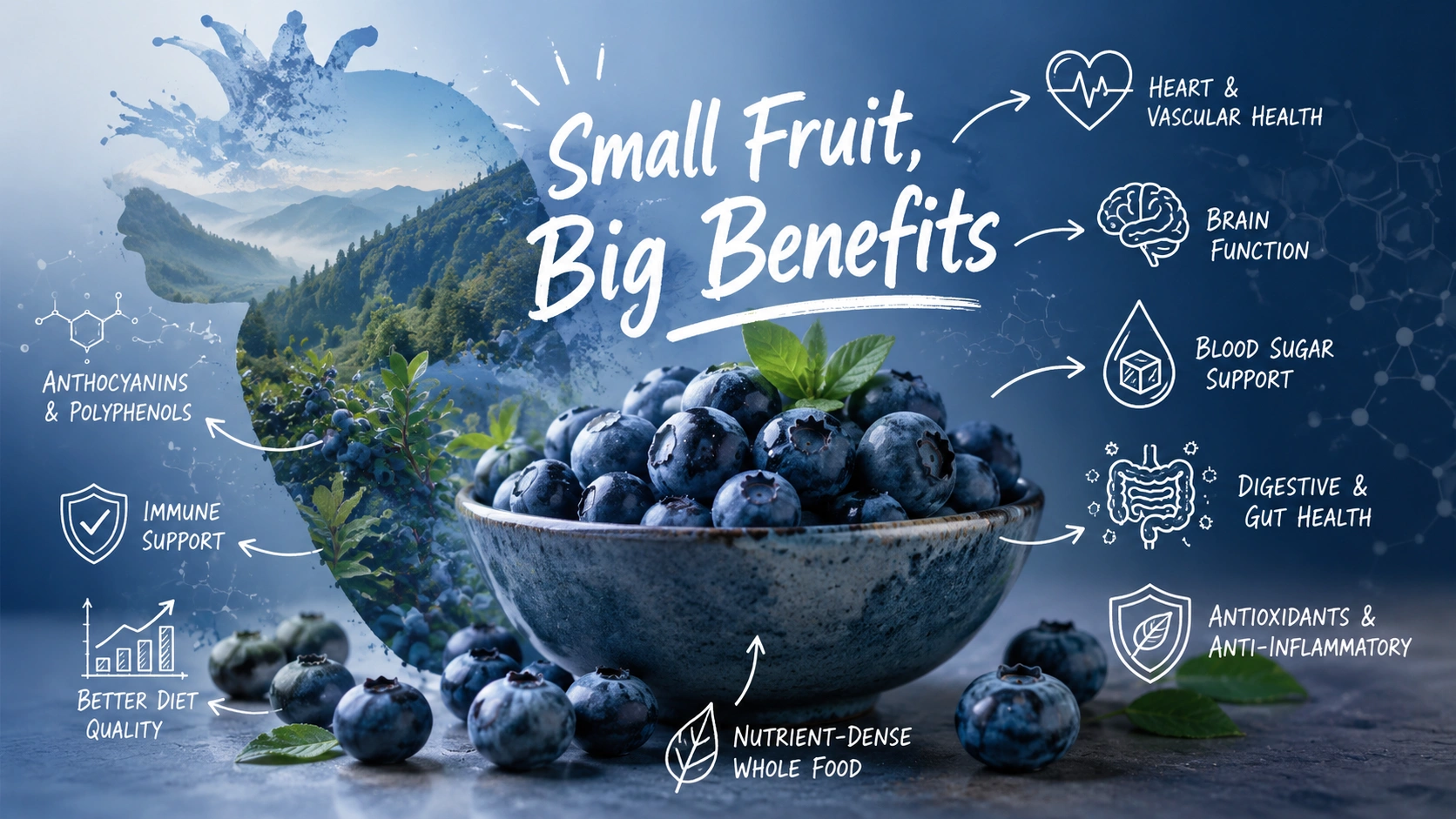
A handful of blueberries does not look particularly powerful. There is no dramatic preparation involved, no rare ingredient, and no need to turn the fruit into a concentrated powder or supplement. Yet beneath the blue-purple skin is a mixture of fiber, vitamins, minerals, and polyphenols that has made blueberries a serious subject of nutrition research.
The most realistic health benefits from blueberries relate to their nutritional value and their potential effects on vascular function, cardiometabolic health, cognitive function, and digestive health. Some of these areas have stronger human evidence than others. Blueberries are nutritious, but they are not a treatment for heart disease, diabetes, dementia, or any other medical condition.
That distinction matters. The interesting story is not that blueberries are a miracle food. It is that an ordinary fruit can deliver fiber and micronutrients while also providing anthocyanins, the pigments responsible for much of its deep color and much of the scientific interest surrounding it.
Why Blueberries Are More Than Just an Antioxidant Food
Blueberries are often introduced with one word: antioxidants.
That description is not wrong, but it can be misleading when left unexplained. Antioxidant activity measured in a laboratory does not automatically mean that eating a food will prevent disease in the human body. Digestion, absorption, metabolism, dose, and interactions with the gut microbiome all influence what happens after a person eats the fruit.
Blueberries contain a group of plant compounds called polyphenols. Among the best known are anthocyanins, pigments that produce red, purple, and blue colors in many fruits and vegetables.
Research reviews have linked regular blueberry and anthocyanin intake with potential effects on vascular function, glucose regulation, inflammatory signaling, and cognitive health. However, the evidence includes a mixture of observational studies and clinical interventions, and results are not equally strong for every proposed benefit.
This creates a more useful way to think about blueberries: not as a medicine hidden in the produce aisle, but as a nutrient-dense whole food whose combination of fiber, micronutrients, and bioactive compounds may support several aspects of health.
7 Potential Health Benefits From Blueberries
1. They Provide Nutrients and Fiber in a Relatively Low-Calorie Food
Before discussing anthocyanins and clinical trials, the simplest benefit deserves attention: blueberries are fruit.
They contribute dietary fiber and provide nutrients including vitamin C, vitamin K, and manganese. U.S. Department of Agriculture resources describe blueberries as a source of these nutrients as well as dietary fiber.
Fiber has a role that is less glamorous than the antioxidant story but more directly relevant to everyday nutrition. It contributes to normal digestive function and can help make meals and snacks more satisfying.
The structure of the whole fruit also matters. A bowl of intact blueberries is nutritionally different from a sweetened blueberry-flavored drink, pastry filling, or candy. Products can contain blueberry ingredients while also containing substantial amounts of added sugar and refined flour.
This is why the health value of blueberries should be understood in the context of the food itself, not the word “blueberry” on a package.
2. They May Support Blood Vessel and Heart Health
Among the proposed benefits of blueberries, cardiovascular and vascular effects have received considerable scientific attention.
Blood vessels are not passive pipes. Their inner lining, called the endothelium, helps regulate vascular tone and blood flow. When endothelial function is impaired, cardiovascular risk can increase over time.
Research on blueberries and anthocyanin-rich foods has examined blood pressure, arterial stiffness, blood lipids, and endothelial function. Reviews of the literature suggest that blueberry consumption may support aspects of vascular function, although effects vary according to the population, dose, duration, and form of blueberry used.
A 2026 systematic review and meta-analysis examining blueberry consumption in healthy individuals reported improvements in vascular function but did not find corresponding improvements in cognitive outcomes for that particular population. This illustrates an important point: a food can have measurable effects in one physiological domain without producing universal benefits across every outcome studied.
The practical interpretation is modest but useful. Eating blueberries as part of a dietary pattern rich in fruits, vegetables, whole grains, legumes, nuts, and other minimally processed foods may contribute to cardiovascular health. Blueberries should not be treated as a substitute for blood pressure treatment, cholesterol management, physical activity, or other clinically appropriate care.
3. They May Help Support Cognitive Function
The connection between blueberries and the brain has generated considerable interest, partly because the brain is highly metabolically active and vulnerable to processes involving oxidative stress, vascular dysfunction, and inflammation.
The proposed mechanisms are biologically plausible. Anthocyanin metabolites and other compounds may influence vascular and cellular pathways relevant to brain function. But biological plausibility is only the beginning of the evidence chain.
Human trials have produced promising but not completely uniform results.
A systematic review of blueberry interventions found that blueberries may improve some measures of cognitive performance, while also emphasizing substantial differences among studies in design, dose, duration, and anthocyanin content.
More recent evidence continues to show that the answer may depend heavily on the population studied. A 2025 systematic review and meta-analysis focused on chronic blueberry consumption and cognitive performance in older adults, bringing together randomized controlled trials in this population.
At the same time, the 2026 meta-analysis in healthy individuals found vascular benefits without clear cognitive improvement.
These findings are not necessarily contradictory. A person experiencing age-related cognitive decline may respond differently from a young or middle-aged healthy adult whose cognitive performance is already relatively high.
For readers, the reasonable conclusion is that blueberries are compatible with a brain-healthy eating pattern, and research on cognition is promising. It is premature, however, to say that eating blueberries prevents dementia or guarantees better memory.
4. They Can Fit Into a Blood Sugar-Conscious Diet
The sweet taste of blueberries sometimes creates a simple question: if they contain natural sugar, are they still appropriate for people concerned about blood glucose?
For most people, the answer is yes. Whole blueberries provide carbohydrates alongside fiber and a complex food matrix. Research has also explored whether blueberry polyphenols may influence glucose regulation and insulin-related pathways.
Systematic reviews and meta-analyses have reported potentially favorable effects on some markers of glycemic control, particularly in people with diabetes or metabolic risk. However, studies have used different berry products, doses, populations, and intervention designs, so the findings should not be interpreted as proof that blueberries treat diabetes.
This is another place where the form of the food matters.
Fresh or unsweetened frozen blueberries are not nutritionally equivalent to blueberry syrup, sweetened dried blueberries, blueberry juice cocktails, muffins, or flavored breakfast products. The latter may contain substantial added sugars and refined carbohydrates.
For someone managing diabetes, the relevant questions include portion size, total carbohydrate intake, medication use, and the composition of the entire meal. Blueberries can be part of that plan, but they are not a replacement for individualized diabetes care.
5. Their Fiber Supports Digestive Health
Not every blueberry benefit requires a complicated biochemical explanation.
Dietary fiber moves through the digestive tract differently from fully digestible carbohydrates. Adequate fiber intake supports bowel regularity and contributes to the overall functioning of the gastrointestinal system.
Blueberries provide fiber in a form that is easy to incorporate into meals. They can be added to oatmeal, plain yogurt, whole-grain cereal, or eaten with nuts as part of a snack.
The benefit is cumulative rather than dramatic. One serving of blueberries will not transform digestive health overnight, but regularly replacing low-fiber snacks with whole fruits can help improve the overall fiber content and nutritional quality of a diet.
If someone currently eats very little fiber, increasing fiber intake rapidly can cause temporary gas, bloating, or abdominal discomfort. Gradual dietary changes and adequate fluid intake may be more comfortable.
6. Their Polyphenols May Interact With the Gut Microbiome
The digestive story becomes more complicated once blueberries reach the colon.
Not all polyphenols are completely absorbed in the small intestine. Some compounds and their metabolites interact with intestinal microorganisms, while gut microbes can also transform polyphenols into other metabolites.
This two-way relationship has made blueberries an interesting subject in microbiome research.
Human studies have begun examining whether regular blueberry consumption changes microbial composition or microbiome-related metabolites. Recent research in older adults with overweight or obesity has explored these effects, but this remains a developing area of science.
The limitation is important. Much of the mechanistic enthusiasm surrounding blueberries and the microbiome has historically come from laboratory and animal research. Human microbiomes also vary considerably between individuals, making broad claims difficult.
It is reasonable to say that blueberry fiber and polyphenols interact with the digestive ecosystem. It is not yet reasonable to promise that a daily bowl of blueberries will “reset” or “heal” the microbiome.
7. They Can Help Improve Overall Diet Quality
The most practical benefit of blueberries may not come from one isolated biochemical pathway.
It may come from what happens when blueberries replace something else.
A cup of blueberries added to breakfast can replace a sugary topping. A bowl of frozen berries can become an alternative to a heavily sweetened dessert. Blueberries packed with nuts or yogurt can replace a vending-machine snack.
This substitution effect is easy to overlook because nutrition research often isolates foods and nutrients for analysis. Real diets do not work that way. Every food choice exists within a pattern of other choices.
Current U.S. dietary guidance emphasizes regular fruit consumption as part of a healthy dietary pattern. Blueberries can contribute to that goal, but they do not need to be the only fruit a person eats. Dietary variety remains valuable because different fruits provide different mixtures of nutrients and phytochemicals.
What Anthocyanins Actually Do
The color of a blueberry is part of its chemistry.
Anthocyanins belong to the flavonoid family of polyphenols. They absorb certain wavelengths of light, creating the red, purple, and blue colors seen in berries and other plant foods.
Their biological story is more complex than simply “neutralizing free radicals.”
In nutrition research, anthocyanins and their metabolites are being studied for possible effects on cellular signaling, inflammatory pathways, vascular function, and metabolic regulation. Reviews of blueberry research have identified vascular and glucoregulatory function among the areas with meaningful scientific interest.
But the concentration of a compound in a food does not tell the entire story. Anthocyanins are metabolized after consumption, and their biological effects may involve metabolites and interactions with the gut microbiota.
This is why statements such as “blueberries prevent oxidative damage” are often too broad. Laboratory antioxidant capacity and clinical health outcomes are different measurements.
The stronger interpretation is that blueberries contain bioactive compounds with plausible biological effects, and human research supports some potential benefits, particularly in vascular and cardiometabolic health. Other claims remain promising but less settled.
Fresh, Frozen, or Dried: Does the Form Matter?
Fresh blueberries have an obvious advantage: they are ready to rinse and eat. But frozen blueberries can be equally practical, especially when berries are out of season or fresh produce is expensive.
For most everyday purposes, unsweetened frozen blueberries are a useful alternative to fresh fruit. They work well in oatmeal, smoothies, yogurt, and cooked dishes.
The larger nutritional difference appears when processing changes the food substantially.
Dried blueberries are more concentrated by volume because much of the water has been removed. Some commercial products also contain added sugar. Blueberry juices and juice drinks remove or reduce the structural advantages of whole fruit and may contain less fiber. Blueberry-flavored foods may contain only small amounts of actual fruit.
Freeze-dried blueberry powder is frequently used in research because it allows investigators to standardize doses and preserve compounds. A study using a measured dose of freeze-dried powder, however, should not automatically be interpreted as evidence that every blueberry product produces the same effect.
For regular eating, the simplest rule is also the most practical: choose fresh or unsweetened frozen blueberries most often, and read ingredient labels on dried, powdered, juice-based, and flavored products.
How Many Blueberries Should You Eat?
There is no scientifically established requirement to eat a specific number of blueberries every day.
A practical serving can be around half a cup to one cup, depending on appetite, dietary needs, total fruit intake, and how the berries fit into meals. The larger goal is maintaining a varied diet that includes fruits and vegetables regularly.
Blueberries can be eaten on their own, but pairing them with other foods can make them more useful in a meal. A few simple options include:
- stir them into oatmeal or overnight oats;
- add them to plain Greek yogurt;
- combine them with nuts or seeds for a more substantial snack;
- use frozen blueberries in smoothies without adding sweetened syrups;
- add them to whole-grain pancakes or baked oatmeal;
- serve them with other fruits to increase dietary variety.
The best pattern is the one that can be maintained. There is little value in forcing a large daily dose of one food while ignoring the quality of the rest of the diet.
Are There Any Risks to Eating Blueberries?
For most people, blueberries are a safe food.
Eating a large amount at once may cause digestive discomfort in some people, particularly if their usual diet is low in fiber. Gradually increasing fiber intake may help reduce bloating or gas.
Food allergy is another consideration. Severe blueberry allergy appears to be rare, but documented allergic reactions, including anaphylaxis, have been reported. Anyone who develops symptoms of a serious allergic reaction after eating a food needs urgent medical evaluation.
People taking warfarin or another medication whose effect can be influenced by vitamin K should follow guidance from their healthcare team. The National Institutes of Health notes that vitamin K can interact with vitamin K-antagonist anticoagulants such as warfarin. The general clinical principle is consistency in vitamin K intake rather than making sudden, unsupervised dietary changes.
This does not mean everyone taking an anticoagulant must avoid blueberries. Medication-specific advice should come from the prescribing clinician or pharmacist.
A Small Fruit With a Realistic Role in a Healthy Diet
The strongest case for eating blueberries does not require calling them a miracle food.
They provide fiber and micronutrients. Their anthocyanins and other polyphenols have been studied for potential effects on vascular health, glucose regulation, cognition, inflammation-related pathways, and the gut microbiome. Human evidence is encouraging in several areas, particularly vascular function, while other proposed benefits remain less certain or may depend on the population studied.
That is enough reason to appreciate blueberries without turning them into medicine.
A bowl of fresh berries at breakfast or a bag of unsweetened frozen blueberries in the freezer represents something nutrition advice often struggles to deliver: a healthy choice that is simple, flexible, and easy to repeat. The benefit comes not from chasing one “superfood,” but from making nutritious foods ordinary parts of everyday eating.
- About the Author
- Latest Posts

Salwa Alifah Yusrina is the Editor-in-Chief at Medslat.com. She is a professional Nutritionist with over 7 years of clinical and research experience. She holds a Master’s degree in Nutrition Science from Hasanuddin University. At Medslat.com, she oversees the editorial direction and ensures that all health and nutrition content adheres to the highest standards of accuracy and evidence-based science.