The phrase “asbestos of the lung” is often used by people trying to understand what happens after asbestos fibers are inhaled. Medically, however, asbestos exposure does not cause just one lung condition.
Breathing airborne asbestos fibers can lead to several different diseases. These include asbestosis, lung cancer, pleural plaques and other pleural abnormalities, and malignant mesothelioma. They are related to asbestos exposure, but they are not the same disease.
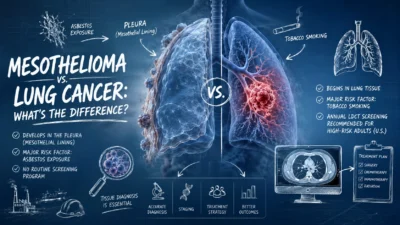
The distinction matters. Asbestosis is a chronic scarring disease of lung tissue. Lung cancer begins in the lung itself. Pleural mesothelioma develops in the mesothelium, the tissue lining the lungs and chest cavity, rather than in the lung tissue itself.
These diseases can also take many years to become apparent after exposure. That long delay is one reason a detailed occupational and environmental history can be important when respiratory symptoms develop later in life.
What Happens When Asbestos Fibers Enter the Lungs?
Asbestos is the name given to a group of naturally occurring fibrous minerals.
When asbestos-containing materials are disturbed, tiny fibers can become airborne. A person may inhale these fibers without seeing them in the air.
Some inhaled fibers can become lodged in the respiratory system. Over time, they may contribute to inflammation, tissue damage, and disease.
The health outcome is not identical for every exposed person. Risk can be influenced by factors including the intensity and duration of exposure, the type and characteristics of the fibers, the time since exposure, and individual factors.
Asbestos exposure has historically occurred in workplaces such as construction sites, shipyards, mines, factories, power plants, and other industrial settings. Exposure can also occur outside the workplace, including during disturbance of asbestos-containing materials or through certain household and environmental pathways.
Exposure does not mean that a person will definitely develop an asbestos-related disease. At the same time, a person with significant past exposure should give that history to a health care professional, particularly when respiratory symptoms or abnormal imaging findings are being evaluated.
Asbestos-Related Diseases Are Not All the Same
One of the biggest problems with the phrase “asbestos of the lung” is that it can blur together several medically distinct conditions.
Understanding the differences makes the rest of the picture much clearer.
Asbestosis
Asbestosis is a chronic lung disease caused by inhaling asbestos fibers.
It is a form of pulmonary fibrosis, meaning that lung tissue becomes scarred. As scarring progresses, the lungs can become less flexible and breathing may become more difficult.
Asbestosis is not cancer.
It is also not the same condition as mesothelioma. Both are associated with asbestos exposure, but they affect the body differently and require different approaches to diagnosis and management.
Symptoms of asbestosis may take many years to appear after the relevant exposure.
Lung Cancer
Asbestos exposure can cause lung cancer.
Unlike pleural mesothelioma, which begins in the tissue lining the chest and lungs, lung cancer develops from cells within the lung.
Smoking and asbestos exposure are separate lung cancer risk factors. For people with a history of both smoking and asbestos exposure, discussing personal risk and appropriate medical care with a clinician is especially important.
A person cannot determine from symptoms alone whether breathing difficulty, coughing, or chest discomfort is caused by asbestosis, lung cancer, COPD, infection, heart disease, or another condition. Proper medical evaluation is necessary.
Malignant Mesothelioma
Mesothelioma is a cancer that develops in the mesothelium, the thin tissue covering and lining certain internal organs.
Pleural mesothelioma affects the lining around the lungs and inside the chest. Although people sometimes describe it as “asbestos lung cancer,” that description is medically inaccurate. Pleural mesothelioma and lung cancer are different cancers.
Asbestos exposure is the major risk factor for mesothelioma.
Symptoms can include shortness of breath and chest pain, but these symptoms are not specific to mesothelioma and can occur in many other conditions.
Pleural Plaques and Other Pleural Disease
Asbestos exposure can also affect the pleura, the membranes surrounding the lungs and lining the inside of the chest.
Pleural plaques are localized areas of thickening that can develop after asbestos exposure. Other asbestos-related pleural abnormalities may include diffuse pleural thickening and pleural effusion.
These conditions are not automatically cancer.
Their clinical significance depends on the specific finding and the person’s broader medical situation. Imaging abnormalities should be interpreted by qualified clinicians rather than used for self-diagnosis.
What Are the Symptoms of Asbestosis?
The symptoms of asbestosis generally develop gradually.
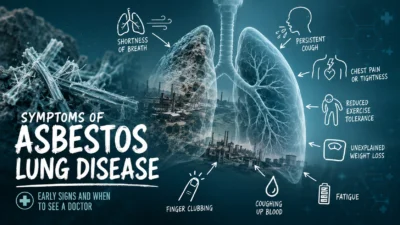
Common features can include:
- progressive shortness of breath;
- persistent dry cough;
- chest discomfort or tightness;
- reduced exercise tolerance.
Some people with advanced disease may develop finger clubbing, a change in the shape of the fingertips and nails.
A health care professional may also detect abnormal breath sounds during a physical examination. These findings are clinical signs rather than symptoms a person can reliably use to diagnose themselves.
The original symptom list commonly circulated in older asbestos articles often mixes together features of several different diseases.
For example, coughing up blood, unexplained weight loss, difficulty swallowing, swelling of the face or neck, pleural effusion, pleural thickening, pulmonary hypertension, and heart complications should not simply be presented as a checklist proving that someone has asbestosis.
Some may occur in other asbestos-related diseases or as complications of advanced cardiopulmonary disease. Others have many possible causes unrelated to asbestos.
New or worsening shortness of breath, persistent cough, chest pain, coughing up blood, or unexplained weight loss warrants medical evaluation.
Why Can Asbestos Disease Appear So Long After Exposure?
Asbestos-related diseases are known for long latency periods.
This means disease may become apparent many years after the exposure occurred. Someone may have worked around asbestos decades earlier and only later develop symptoms or receive an abnormal imaging result.
That delay creates a practical challenge.
A person may no longer work in the same industry. The company may have changed ownership. The building or worksite may no longer exist. The individual may not remember product names or may not have known that asbestos was present at the time.
From a medical perspective, this is why a detailed exposure history can matter.
A clinician may ask about previous occupations, specific job duties, construction or demolition work, shipyard employment, insulation work, military service, industrial settings, and other potential exposure circumstances.
The absence of immediate symptoms after exposure does not prove that future disease is impossible. Conversely, a history of exposure does not mean that every later respiratory symptom is caused by asbestos.
Both the exposure history and the medical findings need careful evaluation.
How Is Asbestosis Diagnosed?
There is no reliable way to diagnose asbestosis by reading a symptom list.
Medical evaluation typically begins with a detailed history and physical examination. A clinician may ask about jobs, industries, military service, duration and intensity of possible exposure, smoking history, symptoms, and previous respiratory diagnoses.
Diagnostic evaluation may include chest imaging and pulmonary function testing.
Chest Imaging
A chest X-ray may reveal changes associated with asbestos-related disease, although imaging findings must be interpreted in clinical context.
Computed tomography, or CT, can provide more detailed images of the lungs and pleura. It may help clinicians evaluate fibrosis, pleural abnormalities, or other findings.
An imaging abnormality alone does not necessarily establish the complete diagnosis. The pattern of findings, exposure history, symptoms, lung function, and alternative explanations all matter.
Pulmonary Function Tests
Pulmonary function tests measure how well the lungs work.
These tests can assess lung volumes, airflow, and the ability of gases to move between the lungs and bloodstream. In asbestosis and other fibrotic lung diseases, testing may show a restrictive pattern or impaired gas transfer.
Results need to be interpreted by clinicians in the context of the individual patient’s condition.
Is a Lung Biopsy Always Needed?
No.
Older articles sometimes imply that lung biopsy is a routine test for everyone suspected of having asbestosis. That is misleading.
Diagnosis often relies on a combination of a credible exposure history, appropriate imaging findings, clinical evaluation, and pulmonary function testing. Additional procedures may be considered when the diagnosis remains uncertain or another disease must be distinguished.
The decision to perform an invasive procedure depends on the individual clinical situation.
Can Asbestos Fibers Be Removed From the Lungs?
Once asbestos fibers have been inhaled and deposited in lung tissue, there is no simple procedure that can wash or clean the lungs.
Treatment therefore focuses on the diagnosed condition, symptoms, complications, and overall respiratory health.
This is another reason prevention of exposure remains critical. Asbestos-containing materials should not be disturbed casually. People who suspect asbestos in a building or material should follow applicable safety requirements and use appropriately trained professionals when assessment or removal is necessary.
Trying to remove suspected asbestos without proper controls can release fibers into the air and create additional exposure.
Is There a Cure for Asbestosis?
There is currently no treatment that reverses the lung scarring caused by asbestosis.
Medical management is individualized and may focus on monitoring lung function, treating symptoms, reducing the risk of respiratory infections, addressing complications, and supporting oxygen levels when clinically indicated.
Smoking cessation is particularly important for overall lung health and cancer risk. People who smoke can ask a health care professional about evidence-based cessation support.
The appropriate treatment plan depends on disease severity, symptoms, other health conditions, and clinical findings.
Asbestosis management should not be confused with treatment for mesothelioma or lung cancer. Those diseases require separate cancer-specific evaluation and treatment planning.
Does Asbestosis Turn Into Cancer?
Asbestosis and cancer are different diseases.
It is misleading to say that asbestosis simply “turns into” lung cancer or mesothelioma.
The common connection is asbestos exposure. Asbestos can cause noncancerous disease, including asbestosis, and it can cause cancers, including lung cancer and mesothelioma.
A person may have one asbestos-related condition without another. Individual risk depends on the exposure and other factors.
This distinction matters because symptoms, diagnostic pathways, prognosis, and treatment differ among these diseases.
When Should Someone With Past Asbestos Exposure See a Doctor?
A person concerned about previous asbestos exposure should discuss that history with a qualified health care professional.
Medical attention is especially important when symptoms develop, including persistent shortness of breath, a persistent cough, chest pain, or other unexplained respiratory changes.
Seek prompt medical attention for serious symptoms such as severe difficulty breathing or coughing up blood.
People should not wait for a long list of symptoms to appear before mentioning a meaningful occupational or environmental exposure history. At the same time, routine testing and screening decisions should be individualized rather than based solely on fear of past exposure.
A clinician can evaluate the exposure history, symptoms, age, smoking history, and other risk factors to determine what assessment is appropriate.
Medical Care Comes Before Legal Questions
People diagnosed with an asbestos-related disease may also have questions about workplace exposure, product manufacturers, compensation, or legal responsibility.
Those questions are separate from diagnosis and treatment.
A lawyer experienced in asbestos litigation may investigate exposure history and potential legal claims, but an attorney cannot diagnose asbestosis, lung cancer, or mesothelioma. Medical evaluation should come from appropriately qualified health care professionals.
Similarly, a medical diagnosis does not automatically establish that a particular company is legally responsible. Legal responsibility depends on evidence and applicable law.
If a person has been diagnosed with an asbestos-related disease and wants to understand possible legal options, they may choose to consult a qualified attorney with relevant asbestos case experience. Filing deadlines and legal rights vary by jurisdiction and individual circumstances.
Understanding “Asbestos of the Lung” Starts With the Right Diagnosis
“Asbestos of the lung” may sound like the name of a single disease, but the medical reality is more complicated.
Inhaled asbestos fibers are associated with several distinct conditions. Asbestosis causes fibrosis of lung tissue. Lung cancer begins within the lung. Pleural mesothelioma develops in the lining around the lungs and chest. Asbestos exposure can also produce noncancerous pleural abnormalities.
These conditions may share an exposure history, but they are not interchangeable.
For someone with past asbestos exposure, the most useful next step is not trying to match every symptom to an online checklist. It is making sure that a clinician knows the exposure history and can evaluate symptoms and findings in the proper medical context.
The exposure may have happened decades ago. The distinction between the diseases still matters today.
- About the Author
- Latest Posts

Salwa Alifah Yusrina is the Editor-in-Chief at Medslat.com. She is a professional Nutritionist with over 7 years of clinical and research experience. She holds a Master’s degree in Nutrition Science from Hasanuddin University. At Medslat.com, she oversees the editorial direction and ensures that all health and nutrition content adheres to the highest standards of accuracy and evidence-based science.