
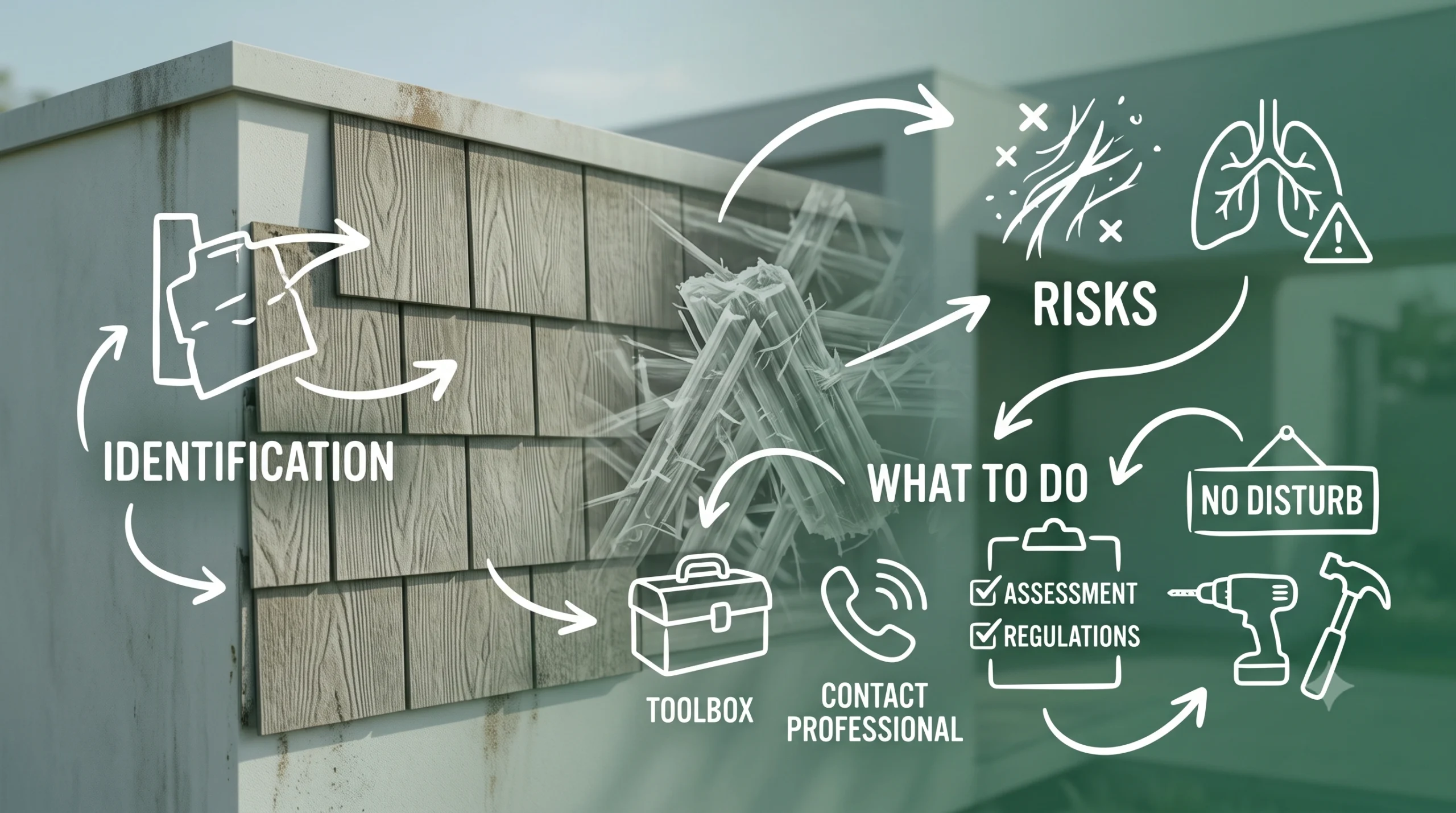
What is asbestos siding? It is an exterior building material made from cement reinforced with asbestos fibers. It was used on many older homes because the combination produced siding that was durable, fire-resistant, and resistant to rot and insects.
Asbestos siding commonly appears as rigid cement shingles or panels attached to the exterior walls of a house. It is often called asbestos-cement siding.
Finding suspected asbestos siding does not automatically mean that people inside the home are being exposed to dangerous concentrations of asbestos fibers. The primary concern is what happens when asbestos-containing material is damaged, broken, drilled, sanded, cut, or otherwise disturbed.
That distinction matters for homeowners.
An older house with intact siding presents a different situation from a demolition or renovation project that will break the material apart. Before repairing or removing suspected asbestos siding, homeowners should understand what the material is, why disturbance matters, and why appearance alone cannot confirm asbestos content.
What Is Asbestos Siding Made Of?
Asbestos siding is generally a cement-based exterior cladding product reinforced with asbestos fibers.
The cement created a hard matrix, while asbestos fibers were incorporated into the product for properties valued by manufacturers and builders. The resulting material could withstand weather, resist fire, and provide a long service life.
Asbestos was used in numerous building products during the twentieth century. Some roofing and siding shingles were made with asbestos cement, according to the U.S. Consumer Product Safety Commission.
The finished siding is different from loose asbestos insulation.
Asbestos-cement products are generally hard and rigid. The fibers are bound within the cement matrix. This affects how easily fibers can be released under normal conditions, although weathering, damage, cutting, grinding, sanding, and demolition can change the exposure situation.
A homeowner should therefore avoid treating every asbestos-containing material as physically identical. Different products have different forms, locations, conditions, and potential for disturbance.
Why Was Asbestos Used in House Siding?
Modern homeowners may wonder why asbestos was intentionally added to building materials.
At the time these products were widely used, manufacturers valued several characteristics of asbestos. The mineral fibers could reinforce cement products while contributing properties useful in construction.
Asbestos-cement siding became attractive because it was:
- resistant to fire;
- durable in outdoor conditions;
- resistant to rot;
- unattractive to many insects and pests;
- dimensionally stable;
- capable of being manufactured in repeatable shingle patterns.
These qualities made the material practical for residential exteriors.
The problem was not that the siding failed to perform as an exterior material. The problem was the health hazard associated with inhaling airborne asbestos fibers and the risks created when asbestos-containing materials are disturbed.
Many examples of asbestos siding remain installed on older homes today.
What Does Asbestos Siding Look Like?
Asbestos siding often appears as rigid rectangular shingles installed in overlapping horizontal rows.
Some products have a flat surface. Others have textured patterns intended to resemble wood grain or other traditional siding materials.
Possible characteristics of older asbestos-cement siding may include:
- individual rigid shingles rather than long flexible strips;
- repeating shingle dimensions;
- a hard cement-like appearance;
- brittle edges or corner damage;
- textured or wood-grain surface patterns;
- predrilled attachment holes in removed pieces;
- older installation beneath newer exterior cladding.
These characteristics are clues, not proof.
Many modern fiber-cement products can resemble older asbestos-cement materials. Other historical siding products may also look similar from a distance.
A photograph, color, texture, or house age cannot confirm asbestos content.
If confirmation is necessary for renovation, repair, sale, or demolition planning, appropriate professional inspection and laboratory analysis may be needed.
Can You Identify Asbestos Siding by Looking at It?
Not reliably.
A homeowner may be able to recognize that siding resembles historical asbestos-cement shingles, but visual identification has limitations.
The problem is that asbestos fibers are microscopic, and several non-asbestos products can resemble asbestos-cement siding. A visual inspection can help identify suspicious material, but it cannot provide the same certainty as appropriate material analysis.
This is particularly important before renovation.
Guessing incorrectly in either direction can create problems. Assuming asbestos-free material contains asbestos can lead to unnecessary concern and expense. Assuming asbestos-containing siding is safe to cut or demolish can create avoidable exposure.
If the siding will remain intact and undisturbed, the immediate decision may be different from a project involving drilling, cutting, removal, or demolition.
The planned activity matters.
Is Asbestos Siding Dangerous?
The risk from asbestos siding depends heavily on the material’s condition and whether it will be disturbed.
Intact asbestos-cement siding is a hard product in which asbestos fibers are bound within cement. Material that remains in good condition and is left undisturbed generally presents a different exposure situation from damaged material being aggressively removed or mechanically worked.
The main concern is airborne fibers.
Activities that break, grind, sand, saw, or otherwise damage asbestos-containing material can release fibers into the air. Those fibers can be inhaled.
Asbestos exposure is associated with serious diseases, including asbestosis, lung cancer, and mesothelioma. These diseases may develop many years after exposure.
This does not mean that every person living in a house with asbestos siding will develop disease.
Risk is related to actual exposure, including factors such as the concentration of airborne fibers, duration and frequency of exposure, and other individual circumstances.
The practical safety principle is simple: suspected asbestos siding should not be unnecessarily disturbed.
When Can Asbestos Siding Release Fibers?
Asbestos-cement siding can become a greater concern when physical work damages the material.
Potentially disturbing activities include:
- sawing;
- sanding;
- grinding;
- drilling;
- breaking shingles;
- crushing removed material;
- dropping brittle pieces during removal;
- aggressive demolition.
Damage from impact or deterioration may also affect the condition of the siding.
Home renovation creates a common decision point. A project that involves installing windows, doors, vents, exterior fixtures, insulation systems, or new cladding may require work on or around the existing siding.
Before beginning, homeowners and contractors should know what materials are present and which requirements apply to the project.
Local and state asbestos rules can differ, and requirements may also depend on the type of building and scope of work.
Should Asbestos Siding Be Removed?
Not automatically.
The presence of asbestos-containing material does not always mean immediate removal is the safest or most appropriate response.
The U.S. Environmental Protection Agency advises that asbestos-containing materials in good condition and left undisturbed are unlikely to present a health risk. The agency also warns that improper removal can increase exposure.
The decision depends on factors such as:
- the condition of the siding;
- whether it is deteriorating or extensively damaged;
- the scope of planned renovation;
- whether work will disturb the material;
- applicable state and local requirements;
- professional assessment of the property.
For some homes, leaving intact material undisturbed may be appropriate.
For others, renovation or extensive damage may make professional removal necessary.
The key point is that removal should not be treated as an automatic do-it-yourself project simply because the material is located outside the house.
Can You Put New Siding Over Asbestos Siding?
In some situations, a new exterior system may be installed over existing siding, but this is a project-specific construction and regulatory question.
Covering existing siding can sound simple, but installation methods may require drilling, fastening, or other disturbance of the underlying material.
Other factors also matter, including:
- wall condition;
- moisture management;
- flashing details;
- window and door transitions;
- added wall thickness;
- local building codes;
- asbestos regulations;
- manufacturer’s installation requirements.
For these reasons, homeowners should not assume that covering asbestos siding automatically eliminates the need for assessment and planning.
A qualified contractor familiar with asbestos requirements and exterior wall assemblies can evaluate the specific project.
Can Asbestos Siding Be Painted?
Painting intact asbestos-cement siding may be possible, but surface preparation methods require careful consideration.
The greatest concern is aggressive preparation that damages the material.
Sanding, grinding, or other abrasive methods can disturb an asbestos-containing surface. Pressure washing or scraping deteriorated material may also create concerns depending on the condition of the siding and the method used.
Before painting suspected asbestos siding, homeowners should determine whether the material is damaged and whether the proposed preparation method could disturb it.
A coating does not make every future activity safe.
If the material is later drilled, cut, broken, or removed, the presence of paint does not eliminate the underlying asbestos issue.
What Should You Do If Asbestos Siding Is Damaged?
Do not begin by breaking off a piece yourself.
If suspected asbestos siding is cracked, deteriorated, or damaged by a storm, construction activity, or impact, avoid unnecessary disturbance of the affected area.
The appropriate response depends on the extent and type of damage.
A professional familiar with asbestos-containing building materials can assess whether repair, stabilization, replacement of limited areas, enclosure, or removal should be considered.
Homeowners should also check local requirements before hiring a contractor.
Asbestos licensing, notification, transport, and disposal rules can vary by jurisdiction and project type. Ordinary construction waste procedures may not apply to asbestos-containing material.
What If You Are Buying a House With Asbestos Siding?
Asbestos siding does not automatically make an older house uninhabitable.
A prospective buyer should evaluate the material as part of the property’s overall condition and future maintenance needs.
Useful questions include:
- Is the siding confirmed to contain asbestos, or is that only suspected?
- What condition is it in?
- Are shingles cracked, missing, or deteriorating?
- Is major exterior renovation planned?
- Will windows or doors be replaced?
- Is another layer of siding already installed over it?
- What are local removal and disposal requirements?
- What could future work cost?
The answers can affect renovation planning and ownership costs.
A home inspection may identify material suspected of being asbestos-cement siding, but laboratory confirmation may require appropriate sampling and testing.
The decision to test should be informed by what the buyer or owner plans to do with the material.
How Is Asbestos Siding Tested?
Testing typically involves collecting a representative sample of the suspected material and having it analyzed by an appropriate laboratory.
Because sampling itself disturbs the material, homeowners should not casually break siding to obtain a sample.
A qualified asbestos inspector or other appropriately authorized professional can determine whether sampling is necessary and how it should be performed under applicable requirements.
The objective is not simply to answer a curiosity question.
Testing is particularly useful when the result will affect a decision about renovation, demolition, repair, contractor selection, or disposal.
Keep records of confirmed asbestos-containing materials with property documentation. Future contractors and owners may need that information before work begins.
Asbestos Siding and Home Renovation
Renovation is one of the most important times to identify asbestos-containing materials.
An exterior remodeling project may disturb siding even when asbestos removal is not the primary purpose of the work.
Projects that may affect siding include:
- window replacement;
- door replacement;
- additions;
- exterior insulation installation;
- electrical work;
- installation of vents or mechanical equipment;
- new siding installation;
- partial demolition;
- full building demolition.
Planning should happen before work starts.
Once material has been broken and debris has been scattered, controlling exposure and cleanup can become more complicated.
The EPA recommends avoiding unnecessary disturbance of asbestos-containing materials and using appropriately trained and accredited professionals when removal is required.
What Are the Health Risks of Asbestos Exposure?
The health concern associated with asbestos siding comes from inhaling airborne asbestos fibers, not simply from seeing the material attached to a wall.
Asbestos exposure can cause serious diseases.
These include asbestosis, a fibrotic lung disease; lung cancer; and mesothelioma, a cancer affecting the lining of the lungs, chest, abdomen, or other organs depending on disease location.
Disease can develop long after the relevant exposure.
The Agency for Toxic Substances and Disease Registry explains that health effects depend on factors including how much asbestos a person was exposed to, how long exposure lasted, how often exposure occurred, and other individual factors.
A person concerned about a significant past exposure should discuss that history with a qualified health care professional.
The presence of asbestos siding on a house does not, by itself, diagnose exposure or disease.
What Should Homeowners Do About Suspected Asbestos Siding?
The first step is to consider what you plan to do.
If the siding is intact and no project will disturb it, the situation is different from damaged siding or a renovation that requires cutting and removal.
A practical approach is to:
- Avoid drilling, sanding, sawing, or breaking suspected material.
- Examine the project scope before exterior work begins.
- Seek professional assessment when identification will affect renovation or removal decisions.
- Check state and local requirements.
- Use appropriately qualified contractors for work that requires asbestos handling.
- Keep testing and abatement records with the property’s documents.
Do not rely on appearance alone when a project requires certainty.
The safest decisions come from matching the response to the material’s condition, the planned work, and applicable regulations.
What Is Asbestos Siding? The Key Point for Homeowners
Asbestos siding is an older exterior cladding material commonly manufactured from cement reinforced with asbestos fibers.
Its presence on a house is not the same as an active airborne exposure event.
The most important issue is disturbance.
Intact material that remains undisturbed presents a different risk profile from siding that is being sawed, sanded, drilled, broken, or demolished. That is why homeowners should identify potential asbestos concerns before renovation begins rather than after material has already been disturbed.
If you suspect your home has asbestos siding, avoid unnecessary damage, consider professional assessment before disruptive work, and check the requirements that apply in your jurisdiction.
Understanding what asbestos siding is helps homeowners make proportionate decisions: neither ignoring a genuine exposure hazard nor assuming that every older siding shingle requires immediate removal.
- About the Author
- Latest Posts

Salwa Alifah Yusrina is the Editor-in-Chief at Medslat.com. She is a professional Nutritionist with over 7 years of clinical and research experience. She holds a Master’s degree in Nutrition Science from Hasanuddin University. At Medslat.com, she oversees the editorial direction and ensures that all health and nutrition content adheres to the highest standards of accuracy and evidence-based science.