For much of the 20th century, asbestos was widely used in industries where heat resistance, fire protection, and insulation were essential. Shipbuilding was one of them.
U.S. Navy personnel and civilian shipyard workers could encounter asbestos while building, maintaining, repairing, or serving aboard ships. Exposure was particularly relevant in enclosed areas where insulation and other asbestos-containing materials could be disturbed during installation, maintenance, or repair work.
The risk was not limited to people who directly handled insulation. Depending on their duties and work environment, sailors and shipyard personnel working near asbestos-related tasks could also inhale airborne fibers released when materials were cut, removed, repaired, or damaged.
Because asbestos-related diseases can take decades to develop, exposure that occurred during World War II and the following decades may remain relevant to the medical and occupational histories of veterans and former shipyard workers.
Why Was Asbestos Used on Navy Ships?
Asbestos is a group of naturally occurring fibrous minerals that resist heat and corrosion. These characteristics made asbestos useful in insulation, fireproofing, friction products, and other industrial applications.
On ships, controlling heat and fire was a major engineering concern. Boilers, steam pipes, turbines, engines, and other equipment could generate intense heat, while vessels also needed fire-resistant materials in areas where space was limited.
Asbestos-containing materials were therefore used in various maritime and industrial applications during the period when the health risks of occupational exposure were not adequately controlled.
The greatest exposure risk occurred when asbestos-containing materials released fibers into the air. Activities such as cutting insulation, removing deteriorated material, repairing pipes, replacing gaskets, and conducting major overhauls could disturb asbestos-containing products.
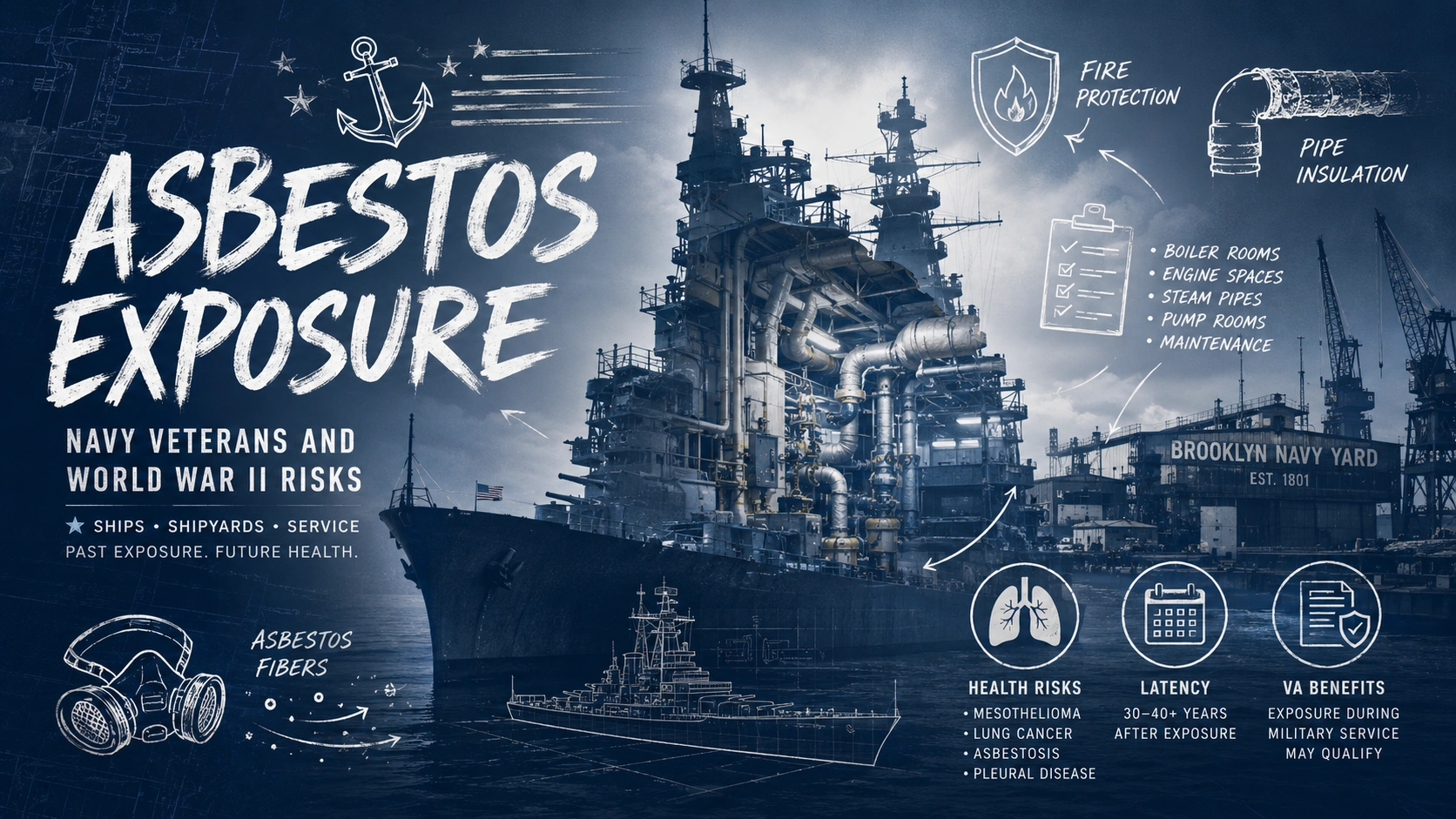
Where Could Asbestos Exposure Occur on Ships?
Exposure conditions varied according to vessel design, occupation, work practices, and the specific materials present. Areas involving heat-generating equipment, steam systems, insulation, and frequent maintenance were particularly important.
Potential exposure locations included:
- boiler rooms;
- engine rooms;
- machinery spaces;
- steam pipe systems;
- pump rooms;
- maintenance and repair areas;
- compartments containing insulated equipment;
- areas undergoing renovation, repair, or overhaul.
Shipboard materials associated historically with asbestos use could include insulation, pipe coverings, gaskets, packing materials, cement products, and certain friction materials.
The presence of an asbestos-containing product did not automatically mean that every person aboard a ship received the same exposure. Risk depended on factors such as whether fibers became airborne, how frequently exposure occurred, the concentration and duration of exposure, ventilation, work practices, and proximity to disturbed material.
Types of Navy Vessels Associated With Potential Asbestos Exposure
Historical asbestos exposure was not limited to one class of ship. Different types of naval vessels contained extensive mechanical, electrical, steam, and fire-control systems that required insulation and regular maintenance.
Vessel categories associated with historical Navy service and shipyard work included:
- Aircraft carriers
- Battleships
- Cruisers
- Destroyers and destroyer escorts
- Frigates
- Minesweepers
- Patrol vessels
- Submarines
- Auxiliary and support vessels
The likelihood and intensity of exposure depended more on the specific vessel, period of service, occupation, assigned compartment, and maintenance activities than on the vessel category alone.
A boiler technician or pipefitter, for example, could have a different exposure history from someone whose duties rarely brought them near machinery spaces or repair work. Even among people with the same occupational title, individual exposure histories can differ substantially.
Shipyard Work and Occupational Asbestos Exposure
Shipyards brought many exposure pathways together in one workplace.
Building and maintaining a naval vessel involved numerous trades working simultaneously in confined or semi-confined spaces. Workers could install insulation, repair machinery, remove damaged materials, replace gaskets, maintain steam systems, or work near other trades performing those tasks.
Occupations with potential historical exposure included:
- boilermakers;
- pipefitters;
- insulators;
- machinists;
- electricians;
- welders;
- maintenance workers;
- shipfitters;
- demolition and renovation workers;
- personnel assigned to machinery and engineering spaces.
Job title alone cannot establish the intensity of a person’s exposure. A meaningful exposure history considers what tasks were performed, where the work occurred, which materials were handled or disturbed, how often the work took place, and whether respiratory protection and other controls were used.
The Brooklyn Navy Yard During World War II
The Brooklyn Navy Yard was one of the most important naval shipbuilding facilities in the United States.
Established in 1801, the Yard operated as a naval shipbuilding facility for 165 years. Its activity reached its peak during World War II, when approximately 70,000 people worked there.
The Yard built and supported major U.S. warships over its long history, including the USS Arizona and USS Missouri. Its wartime workforce included people performing a wide range of industrial trades required for ship construction, outfitting, maintenance, and repair.
This scale of activity provides important historical context for evaluating potential occupational exposures. Large shipyards combined heavy industry, machinery, steam systems, insulation work, welding, pipefitting, electrical work, and extensive maintenance operations.
However, employment at a particular shipyard does not by itself establish that a person experienced a specific dose of asbestos exposure. Individual exposure assessment still depends on occupation, work location, tasks, materials, and duration of contact.
Asbestos Exposure and Health Risks
Inhaling asbestos fibers can cause serious diseases, although exposure does not mean that a person will necessarily develop an asbestos-related condition.
Established health effects associated with asbestos exposure include:
- mesothelioma;
- lung cancer;
- asbestosis;
- pleural disease.
Mesothelioma is a rare cancer that can affect the tissue lining the chest cavity, abdominal cavity, and other organs. Asbestosis is a chronic lung disease caused by inhaled asbestos fibers and involves scarring of lung tissue.
The risk of disease varies according to multiple factors, including the characteristics of exposure. Smoking is an especially important additional risk factor for lung cancer among people exposed to asbestos, but smoking does not cause mesothelioma.
Why Asbestos-Related Diseases May Appear Decades Later
One of the defining characteristics of asbestos-related disease is the long interval that can occur between exposure and illness.
For mesothelioma, signs may not appear until approximately 30 to 40 years after asbestos exposure. Other asbestos-related diseases can also have long latency periods.
This long delay can make exposure reconstruction difficult. A veteran or former shipyard worker may need to consider employment records, military occupation, vessel assignments, duty stations, repair activities, and other occupational or environmental exposures that occurred many years earlier.
Latency should not be interpreted as evidence that disease is inevitable after exposure. Many people exposed to asbestos do not develop mesothelioma or another asbestos-related disease.
Secondary or Take-Home Asbestos Exposure
Asbestos exposure was not always confined to the workplace.
Historically, workers exposed to asbestos could carry fibers or contaminated dust away from a worksite on clothing or other personal items. Household members could then come into contact with the contaminated material, including during the handling or laundering of work clothes.
This pathway is often described as secondary, household, or take-home exposure.
The possibility of secondary exposure reinforces the importance of understanding a person’s complete exposure history rather than considering only direct occupational handling of asbestos-containing products.
Modern asbestos-control practices are designed to prevent fibers from spreading beyond controlled work areas. People should not attempt to remove or disturb suspected asbestos-containing materials without following applicable safety requirements and obtaining qualified professional assistance when needed.
VA Benefits for Veterans Exposed to Asbestos
Veterans with health conditions related to asbestos exposure during military service may be eligible for VA disability compensation.
According to current VA eligibility information, a veteran may qualify for disability compensation based on asbestos exposure when both of the following are true:
- the veteran has a health condition caused by asbestos exposure; and
- the veteran had contact with asbestos while serving in the military.
VA evaluates asbestos-related disability claims based on the evidence and circumstances of the individual claim.
This corrects a significant misconception: mesothelioma is not categorically excluded from consideration simply because it developed after military service. Veterans can file claims for health problems they believe are related to asbestos exposure during military service.
A veteran also does not necessarily have to prove that military service was the only asbestos exposure that ever occurred. The central issue for a service-connected disability claim is whether the evidence supports a connection between the health condition and asbestos exposure during military service under applicable VA requirements.
Relevant evidence may include military service records, occupational specialty, vessel or duty assignments, medical records, exposure history, and medical evidence concerning the relationship between the disease and service-related exposure.
Documenting a Military Asbestos Exposure History
Because asbestos exposure often occurred decades before disease was diagnosed, organizing historical information can be valuable.
A veteran reviewing a possible service-related exposure history may consider:
- Branch of service and dates of service
- Military occupational specialty or rating
- Ships and vessels on which the veteran served
- Shipyards and naval facilities where the veteran worked
- Specific compartments or work areas
- Maintenance, repair, overhaul, or demolition tasks
- Materials handled or disturbed
- Duration and frequency of potential exposure
- Civilian occupations before and after military service
- Medical diagnosis and treatment records
The purpose of reconstructing an exposure history is not to assume that every historical ship or shipyard contained the same materials or created identical exposure conditions. It is to build a detailed, evidence-based account of where and how exposure may have occurred.
What Veterans Concerned About Asbestos Exposure Can Do
Exposure to asbestos does not automatically mean that disease will develop. Veterans who are concerned about a past exposure or possible health effects can discuss their history with a healthcare professional.
Useful information to provide may include the period of service, military occupation, vessels or facilities involved, specific work duties, and known civilian asbestos exposure before or after military service.
Veterans who have an asbestos-related health condition and believe it is connected to military exposure can also review current VA eligibility requirements and claims procedures.
Because medical evaluation and benefits claims involve different types of evidence, veterans may need both accurate medical documentation and a detailed service and occupational history.
The Bottom Line
Navy veterans and shipyard workers were among the occupational groups that could encounter asbestos during the decades when the material was widely used for insulation, heat resistance, and fire protection.
Potential exposure occurred across many vessel types and work environments, particularly in machinery spaces, steam systems, maintenance operations, and shipyard repair activities. The Brooklyn Navy Yard illustrates the enormous scale of wartime shipbuilding, reaching a workforce of approximately 70,000 people at the height of World War II.
The health effects of asbestos exposure may not become apparent for decades. Mesothelioma, lung cancer, asbestosis, and pleural disease are among the conditions associated with exposure, although an exposure history alone does not determine whether disease will develop.
Veterans with an asbestos-related health condition may be eligible for VA disability compensation when the evidence supports exposure during military service and a relationship between that exposure and the health condition. Accurate medical evaluation, detailed exposure history, and service documentation are central to understanding both health concerns and potential benefit eligibility.
- About the Author
- Latest Posts

Salwa Alifah Yusrina is the Editor-in-Chief at Medslat.com. She is a professional Nutritionist with over 7 years of clinical and research experience. She holds a Master’s degree in Nutrition Science from Hasanuddin University. At Medslat.com, she oversees the editorial direction and ensures that all health and nutrition content adheres to the highest standards of accuracy and evidence-based science.