Choosing a lawyer after a mesothelioma diagnosis is different from hiring an attorney for a routine legal matter. The exposure that may have contributed to the disease could have occurred decades earlier, at several workplaces, through multiple asbestos-containing products, or even through fibers carried home on another person’s work clothes.
That history makes asbestos cases unusually dependent on investigation.
The right mesothelioma lawyer should have substantial experience with asbestos claims, the resources to reconstruct a long exposure history, a clear explanation of fees and expenses, and the ability to identify the legal options that may apply to the specific facts of a case.
No lawyer can guarantee a settlement amount or trial result. A better way to choose counsel is to ask specific questions about experience, resources, jurisdiction, fees, communication, and who will actually handle the case.
Why Mesothelioma Cases Require Specialized Legal Experience
Mesothelioma is a rare cancer strongly associated with asbestos exposure. Because the disease can develop many years after exposure, a legal investigation may need to reconstruct events from decades earlier.
A person may remember working at a shipyard, refinery, power plant, construction site, automotive shop, factory, or military facility. But building a legal claim can require much more detail:
- the dates and locations of employment;
- specific job duties;
- contractors and subcontractors at the site;
- equipment that was installed or repaired;
- insulation, gaskets, packing, brakes, cement, or other materials that may have been present;
- coworkers who can confirm working conditions;
- household exposure involving contaminated work clothing;
- company and product histories;
- prior asbestos litigation involving relevant workplaces or products.
This is one reason experience with general personal injury cases does not automatically translate into asbestos litigation experience.
An established asbestos practice may have accumulated records from previous investigations, including worksite histories, product information, deposition testimony, corporate records, and other evidence. The usefulness of those resources depends on the facts of the individual case, but the ability to investigate historical exposure is an important criterion when comparing firms.
First, Understand What a Mesothelioma Lawyer Can Actually Do
A mesothelioma lawyer evaluates whether the facts may support one or more legal claims. Depending on the circumstances, potential sources of recovery can involve personal injury litigation, wrongful death claims, asbestos bankruptcy trusts, workers’ compensation, or other legal programs.
Not every option applies to every person.
A lawyer may investigate exposure history, identify potentially responsible entities, determine where claims may legally be filed, preserve evidence, obtain records, prepare court filings, conduct discovery, negotiate potential settlements, and take a case toward trial when appropriate.
The attorney should also explain the limits of the case. A reputable lawyer should be willing to discuss weaknesses, evidentiary problems, filing deadlines, and uncertainty rather than promising a particular result.
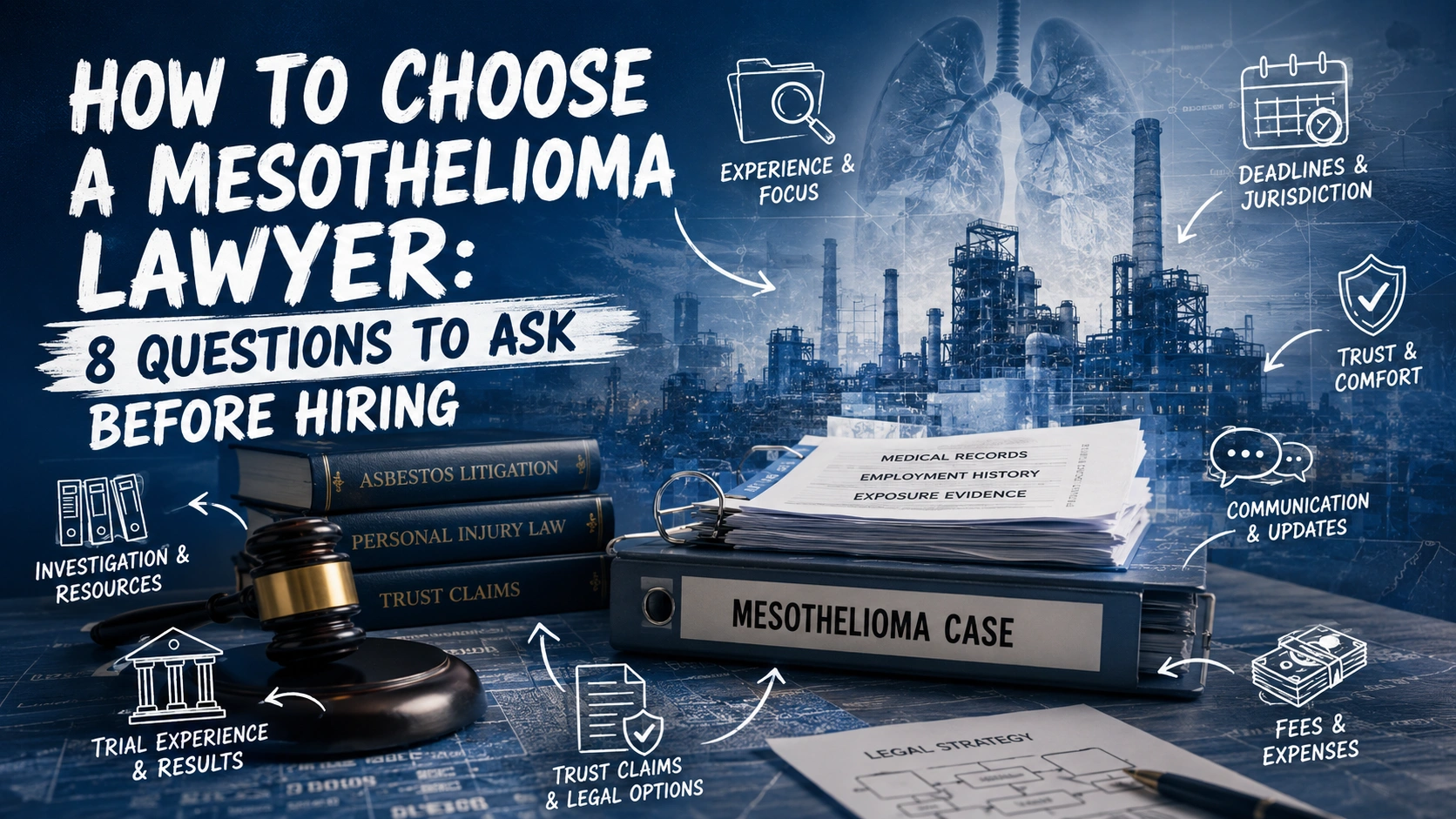
Before hiring anyone, consider the following eight questions.
1. How Much Experience Do You Have With Mesothelioma and Asbestos Cases?
Start with specific experience.
Ask how long the attorney or firm has handled asbestos cases and how much of the practice is devoted to this area. A firm that occasionally accepts an asbestos case is different from a practice with dedicated attorneys, investigators, and other resources for historical exposure research.
Useful follow-up questions include:
- How many mesothelioma cases have you personally handled?
- Does your firm regularly investigate occupational exposure dating back several decades?
- Have you handled cases involving my industry, occupation, worksite, or type of exposure?
- Who will supervise my case?
- Does the firm have experience preparing asbestos cases for trial?
Experience should be evaluated carefully. A large number displayed on a website does not tell you how the firm will handle your individual case.
Ask what the lawyer’s experience means in practical terms. Can the team explain how it reconstructs exposure? Does it know how to investigate old companies and products? Can it identify the evidence needed when employers or manufacturers no longer exist?
The quality of those answers is more useful than a marketing slogan.
2. Who Will Actually Handle My Case?
The lawyer conducting the initial consultation may not be the person managing the case from day to day.
Ask directly who will be responsible for your file.
A legal team may legitimately include partners, associates, paralegals, investigators, medical-record specialists, and outside experts. Team-based representation is not inherently a disadvantage. What matters is knowing who is responsible for important decisions and how communication will work.
Ask:
- Who is the primary attorney responsible for my case?
- Who will be my regular point of contact?
- How often should I expect updates?
- Who returns calls and emails?
- Will another law firm share responsibility for the case?
- Could my case be referred to or jointly handled with another firm?
If another firm may become involved, ask how responsibilities and attorney fees will be handled.
You should understand the representation structure before signing an agreement, not discover it after the case has begun.
3. How Will You Investigate My Asbestos Exposure?
For many mesothelioma claims, exposure investigation is central to the case.
A diagnosis alone does not identify when, where, or how exposure occurred. The legal team may need to develop a detailed occupational and residential history and compare it with information about worksites, products, suppliers, contractors, and historical corporate relationships.
Ask the lawyer to explain the investigation process in plain language.
A strong answer should go beyond saying that the firm has an “asbestos database.” Ask what kinds of records and investigative resources the firm actually uses and how those resources might apply to your history.
Depending on the case, an investigation may involve employment records, Social Security employment histories, military records, union information, witness interviews, prior testimony, corporate documents, product identification evidence, and historical worksite research.
The relevant evidence will differ from case to case.
A Navy veteran exposed during ship maintenance may require a different investigation from a construction worker who cut asbestos-containing materials or a family member who experienced secondary household exposure.
The lawyer should be able to explain how the investigation would be tailored to the exposure history rather than offering a generic description.
4. Where Can My Claim Be Filed, and What Deadlines Apply?
The old assumption that a person should simply hire the nearest lawyer is too simplistic.
Asbestos cases can involve complicated questions about jurisdiction and venue. Relevant connections may include where the person lived, where exposure occurred, where a defendant conducted business, and other legally significant facts.
The applicable statute of limitations also matters. Filing deadlines differ by jurisdiction and claim type, and wrongful death claims may be governed differently from personal injury claims.
For that reason, ask:
- Which jurisdictions could potentially apply to my case?
- Why do you recommend filing in a particular jurisdiction?
- What filing deadlines may apply?
- What information do you need to determine those deadlines?
- Are you admitted to practice there, or will another firm or local counsel participate?
A national practice may offer broad resources and experience across jurisdictions. A local firm may offer valuable familiarity with a particular court system. Neither characteristic, by itself, proves that one firm is better.
The relevant question is whether the legal team has the appropriate experience, resources, licenses, and relationships for the specific case.
Because filing deadlines can affect legal rights, people considering a claim should seek individualized legal advice promptly rather than relying on a general article to calculate a deadline.
5. How Do Your Contingency Fees and Case Expenses Work?
Many personal injury lawyers use a contingency fee arrangement. Under this structure, the attorney’s fee is tied to a successful recovery rather than being billed as a conventional hourly legal fee.
That simple description does not answer every financial question.
Before signing an agreement, ask:
- What percentage of the recovery is charged as the attorney fee?
- Does the percentage change if a lawsuit is filed or the case goes to trial?
- What expenses might be advanced during the case?
- Are expenses deducted before or after the attorney fee is calculated?
- Who is responsible for expenses if there is no recovery?
- Could another law firm receive part of the attorney fee?
- Will I receive a written explanation of the final distribution?
The distinction between fees and expenses is important.
Court filing fees, deposition costs, record retrieval, expert witnesses, travel, and other litigation expenses may be treated separately from the attorney’s contingency fee. The agreement should explain how these costs are handled.
Do not assume that “no upfront fee” and “you owe absolutely nothing if the case is unsuccessful” always mean exactly the same thing. Read the written agreement and ask the lawyer to explain any provision you do not understand.
6. Do You Handle Both Lawsuits and Asbestos Bankruptcy Trust Claims?
Asbestos compensation does not come from one universal fund or one legal process.
Some companies that faced asbestos liabilities entered bankruptcy proceedings and established trusts to compensate eligible present and future claimants. A trust claim is different from a lawsuit against a solvent defendant.
Depending on the facts, a person may potentially qualify for claims involving one or more trusts while also having other legal claims. The availability and coordination of these options can involve complex legal and procedural questions.
Ask prospective counsel:
- Does the firm regularly prepare asbestos trust claims?
- How will you determine which trusts may apply to my exposure history?
- Could trust claims affect other parts of my case?
- How will you explain the timing and coordination of different claims?
- What documentation will be needed?
The lawyer should explain the potential avenues of compensation without promising that a particular trust payment, settlement, or verdict will occur.
7. What Is Your Actual Trial Experience?
Most civil claims do not end with a jury verdict, but trial preparation can still matter.
When a firm advertises large verdicts or settlements, ask for context. Past outcomes do not guarantee future results, and a headline number from an unrelated case may say little about the value or strength of another person’s claim.
More useful questions include:
- How many asbestos cases has the firm taken to trial?
- Who would serve as trial counsel in my case?
- Does the lawyer responsible for my case have courtroom experience?
- How does the firm decide whether to recommend accepting a settlement?
- Who makes the final decision about accepting or rejecting a settlement offer?
The client should receive legal advice about risks and options. The lawyer should explain how recommendations are made without presenting past awards as promises of future compensation.
Be cautious when marketing language focuses almost entirely on very large verdicts without explaining that every case depends on its own exposure evidence, defendants, jurisdiction, medical evidence, procedural history, and other facts.
8. Do I Feel Comfortable Communicating With This Legal Team?
Technical experience matters, but communication also affects the attorney-client relationship.
A mesothelioma case can involve discussions about medical records, employment history, military service, family circumstances, and events that happened decades ago. Clients should be able to ask questions and receive understandable answers.
During an initial consultation, pay attention to how the legal team communicates.
Do they explain the process clearly? Do they answer difficult questions directly? Are they willing to discuss uncertainty? Do they pressure you to sign immediately? Can they explain who will contact you and how often?
Comfort should not be confused with charisma.
The most reassuring lawyer in an initial conversation is not necessarily the most qualified. Evaluate communication alongside experience, investigative capacity, fee transparency, and the proposed legal strategy.
Questions to Ask During a Mesothelioma Lawyer Consultation
An initial consultation is an opportunity to compare firms systematically.
Consider asking:
- How much of your practice involves asbestos and mesothelioma claims?
- Have you handled cases involving my occupation, industry, worksite, military service, or exposure pattern?
- Who will be responsible for my case?
- How will you investigate exposures that occurred decades ago?
- What jurisdictions and filing deadlines may apply?
- Do you handle asbestos bankruptcy trust claims as well as lawsuits?
- What is the contingency fee percentage?
- What case expenses could be deducted from a recovery?
- Could I owe any expenses if there is no recovery?
- Will another law firm participate in or receive a fee from the case?
- What information and documents do you need from me?
- How often will I receive case updates?
- What are the strongest and weakest aspects of the potential claim?
- What can you realistically tell me at this stage, and what still needs investigation?
You do not need to accept representation during the first conversation.
Comparing the answers from more than one qualified lawyer can help clarify differences in experience, communication, resources, and proposed strategy.
Verify the Lawyer, Not Just the Website
A polished website is not evidence that an attorney is licensed, in good standing, or experienced in the type of case being advertised.
Before hiring a lawyer, verify the attorney through the appropriate state bar or attorney regulatory authority. Depending on the jurisdiction, public records may provide information about license status and disciplinary history.
Also read the representation agreement carefully.
Confirm the identity of the law firm you are hiring, the attorney or team responsible for the case, the fee structure, the handling of expenses, and any provisions concerning associated counsel or referral arrangements.
If something in the agreement differs from what was said during the consultation, ask for clarification before signing.
A Note About Current U.S. Asbestos Regulation
Older discussions of asbestos law often say simply that asbestos is “not banned in the United States.” That statement no longer provides an adequate picture of current federal regulation.
In 2024, the EPA finalized a rule prohibiting ongoing uses of chrysotile asbestos, the only known form of asbestos then being imported, processed, or distributed for use in the United States. The rule includes different compliance timelines for covered uses.
Workplace exposure is also regulated separately.
OSHA’s general industry asbestos standard sets an airborne permissible exposure limit of 0.1 fiber per cubic centimeter of air as an eight-hour time-weighted average and an excursion limit of 1.0 fiber per cubic centimeter averaged over 30 minutes.
These airborne exposure limits should not be confused with definitions based on the percentage of asbestos in a material.
The claim that asbestos below 1% is automatically harmless is incorrect. OSHA has explained that the presence of asbestos below 1% in a material does not mean that disturbing the material is necessarily safe or outside all regulatory requirements.
For a legal claim, the relevant issues are also broader than whether a workplace exceeded one regulatory threshold. Liability questions depend on the applicable law, the evidence, the parties involved, and the specific circumstances of the exposure.
What Happens After a Lawyer Accepts a Mesothelioma Case?
The exact process varies, but a case may move through several broad stages.
The legal team first investigates the diagnosis, exposure history, employment, military service, residences, and other potentially relevant facts. Medical and employment records may be collected, witnesses may be interviewed, and potentially responsible entities may be identified.
The attorney then determines which legal claims may be available and where they may properly be pursued. Depending on the facts, this can involve court litigation, bankruptcy trust claims, or other compensation systems.
If a lawsuit is filed, the case may proceed through discovery. This can involve document exchange, written questions, depositions, expert evidence, motions, and negotiations.
Some claims resolve through negotiated settlements. Others may proceed further toward trial. Bankruptcy trust claims follow their own administrative procedures and eligibility requirements.
The timing and sequence differ substantially among cases. A lawyer evaluating an individual claim should explain the expected process based on the relevant jurisdiction, defendants, exposure evidence, and available claim mechanisms.
Choosing Based on Evidence, Not Promises
The strongest reason to hire a mesothelioma lawyer is not that the attorney promises a particular amount of money. It is that asbestos cases can require specialized historical investigation, knowledge of multiple compensation systems, careful attention to filing deadlines, and the resources to develop evidence from events that may have occurred decades ago.
When comparing lawyers, focus on verifiable qualities: relevant experience, exposure-investigation capability, trial preparation, clear fee terms, communication practices, and a credible explanation of the potential legal strategy.
A diagnosis can create pressure to make decisions quickly. Filing deadlines are a legitimate reason to obtain legal advice promptly, but pressure from a lawyer to sign without understanding the representation agreement is something different.
The right attorney should be able to explain both what the legal team can do and what it cannot promise. That distinction is one of the most useful signals when deciding whom to trust with a mesothelioma claim.
Writer: Salwa Alifah Yusrina
- About the Author
- Latest Posts

Salwa Alifah Yusrina is the Editor-in-Chief at Medslat.com. She is a professional Nutritionist with over 7 years of clinical and research experience. She holds a Master’s degree in Nutrition Science from Hasanuddin University. At Medslat.com, she oversees the editorial direction and ensures that all health and nutrition content adheres to the highest standards of accuracy and evidence-based science.