A mesothelioma diagnosis can raise two urgent but very different sets of questions. The first concerns treatment. The second concerns how asbestos exposure happened, whether companies or products may be legally responsible, and what options are available to the patient and family.
A mesothelioma lawyer investigates those legal questions.
These attorneys handle claims involving asbestos exposure and may help eligible clients pursue compensation through personal injury lawsuits, asbestos bankruptcy trust claims, settlements, verdicts, or wrongful death claims. The available options depend on the facts of the case, exposure history, potentially responsible companies, jurisdiction, and applicable filing deadlines.
No attorney can responsibly guarantee a particular outcome or compensation amount. Mesothelioma cases can involve decades-old employment records, military service, job sites, products, witnesses, corporate histories, and multiple possible sources of exposure.
That complexity is precisely why experience matters.
What Does a Mesothelioma Lawyer Do?
A mesothelioma lawyer represents people and families pursuing legal claims related to asbestos exposure.
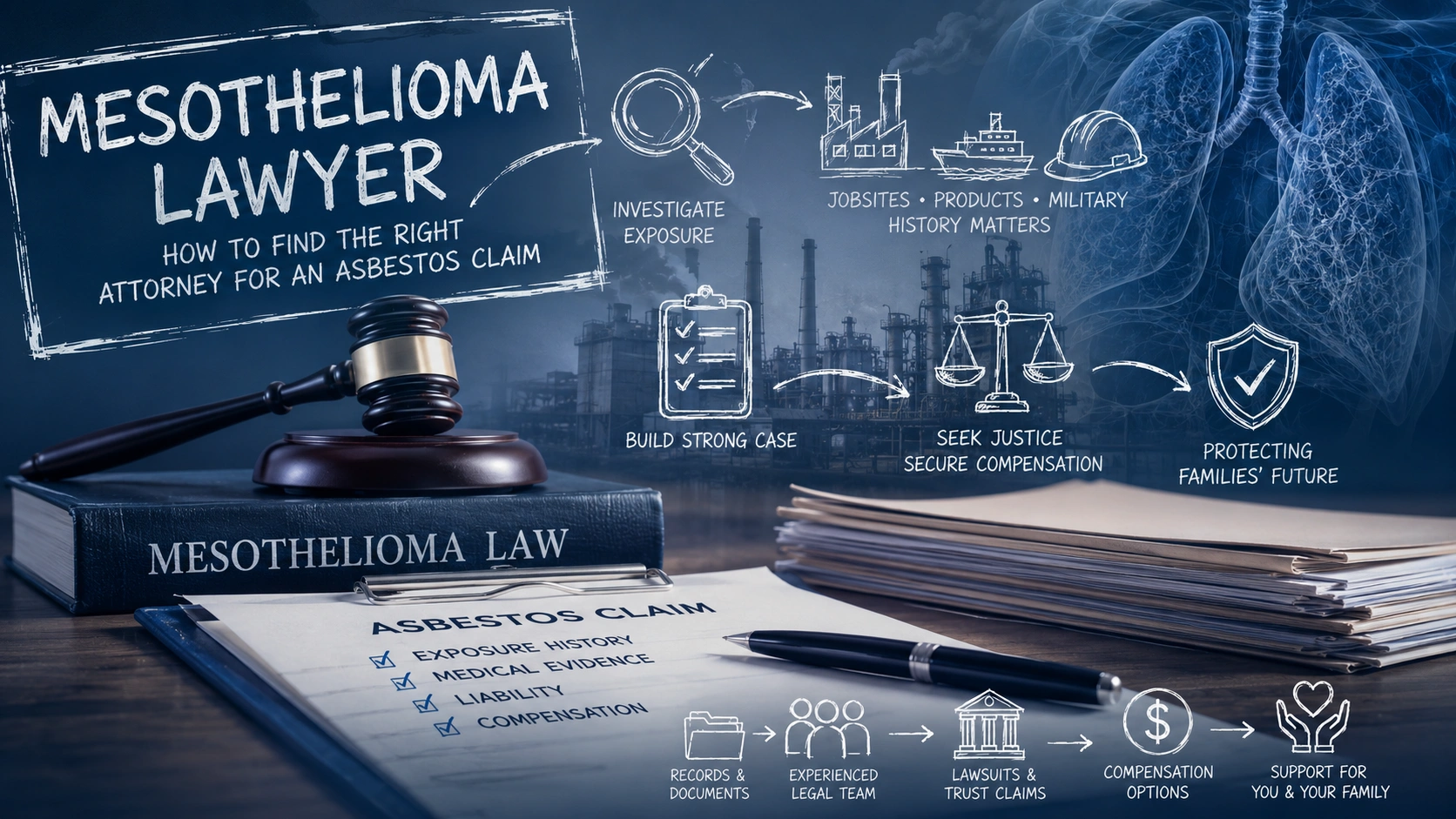
The work often begins with a detailed investigation. Because mesothelioma can develop long after the relevant exposure, reconstructing where and how contact with asbestos occurred may require more than remembering one employer.
An attorney and legal team may investigate:
- employment and union records;
- military service records;
- job sites and contractors;
- asbestos-containing products;
- manufacturers and suppliers;
- corporate ownership and successor companies;
- coworkers or other potential witnesses;
- residential or household exposure;
- medical records and pathology documentation;
- previous asbestos claims associated with particular sites or products.
The objective is to connect documented exposure with potentially responsible entities and determine which legal avenues may be available.
That process can be particularly important when a patient worked at several sites, held different jobs, served in the military, or encountered asbestos-containing materials manufactured by multiple companies.
Why Asbestos Exposure History Matters
Mesothelioma is a cancer of the mesothelium, the thin tissue lining certain internal organs. The National Cancer Institute identifies asbestos exposure as the major risk factor for mesothelioma.
Historically, asbestos was used in many industrial and construction applications because of properties such as heat resistance and durability. Exposure could occur when asbestos-containing materials released fibers into the air and those fibers were inhaled or swallowed.
Occupational exposure has been a major concern, but it is not the only possible exposure pathway.
Some people may have encountered asbestos through contaminated work clothing brought home by a household member. Others may have experienced environmental or nonoccupational exposure. For a legal investigation, the relevant history can therefore extend beyond a single employer.
A lawyer cannot determine medical causation independently. Medical diagnosis and treatment belong to qualified health care professionals. The legal team’s role is to investigate exposure history, identify potentially responsible parties or funds, and evaluate possible claims under applicable law.
When Should You Contact a Mesothelioma Attorney?
Someone diagnosed with mesothelioma may want to seek legal advice promptly after the diagnosis is confirmed.
The reason is practical: legal claims are subject to deadlines, commonly known as statutes of limitations. The applicable deadline can depend on state law, the type of claim, where exposure occurred, where the defendant does business, where the patient lives, and other jurisdictional factors.
Wrongful death claims may have different filing rules from claims brought by a living patient.
Waiting can also make an investigation harder. Employment records may become more difficult to locate, witnesses may become unavailable, and memories of old workplaces and products may fade.
Speaking with an attorney does not require a person to file a lawsuit. An initial evaluation can help determine whether a potential claim exists, what information is needed, and which deadlines may apply.
Types of Mesothelioma and Asbestos Claims
There is no single compensation process that applies to every mesothelioma case.
Depending on the circumstances, a lawyer may investigate one or more potential sources of recovery.
Personal Injury Lawsuits
A person living with mesothelioma may be able to bring a personal injury claim against companies alleged to be legally responsible for asbestos exposure.
The defendants and legal theories vary by case. Potential litigation may involve manufacturers, suppliers, contractors, premises owners, or other entities, depending on the exposure history and applicable law.
A lawsuit does not guarantee a trial.
Some cases resolve through negotiated settlements, while others proceed further through litigation. Outcomes depend on the evidence, defendants, jurisdiction, procedural history, and other case-specific factors.
Asbestos Bankruptcy Trust Claims
Some companies with substantial asbestos liabilities entered bankruptcy proceedings and established trusts to compensate eligible present and future claimants.
Trust claims are different from lawsuits against solvent defendants.
Each trust has its own eligibility criteria and claim procedures. Documentation requirements may include evidence of diagnosis and qualifying exposure connected to products, companies, or job sites covered by the trust.
A person may potentially qualify for claims involving more than one trust or have other legal claims, depending on the exposure history and applicable rules.
Because the interaction between trust claims and litigation can be complex, claim strategy should be evaluated on the facts of the individual case.
Wrongful Death Claims
When a person dies from mesothelioma, eligible surviving family members or the estate may have legal options under applicable state law.
Wrongful death laws vary. Rules can differ regarding who may file, what damages may be available, where the claim can be brought, and how long the claimant has to act.
A lawyer evaluating a potential wrongful death case may review medical evidence, exposure history, prior claims or lawsuits, family relationships, estate documents, and the laws of relevant jurisdictions.
Families should not assume that a previous claim automatically eliminates every possible legal option, or that a wrongful death claim is automatically available. The answer depends on the circumstances and applicable law.
How Mesothelioma Compensation Works
Compensation is one of the main reasons people seek a mesothelioma lawyer, but advertising around asbestos litigation can create unrealistic expectations.
There is no universal settlement amount.
Potential compensation depends on factors that may include the strength of the evidence, identified defendants, available trust claims, jurisdiction, exposure history, medical circumstances, procedural posture, and whether a matter settles or proceeds to a verdict.
Potential sources may include:
- settlements with defendants;
- jury verdicts;
- asbestos bankruptcy trust payments;
- other benefits or claims for which the individual separately qualifies.
These pathways are not interchangeable, and eligibility varies.
Published reports of exceptionally large verdicts should also be interpreted carefully. A verdict in one case does not predict the result of another, and verdicts may be appealed, reduced, or otherwise affected by subsequent proceedings.
A responsible attorney should evaluate the specific case rather than promise that a client will receive a particular amount.
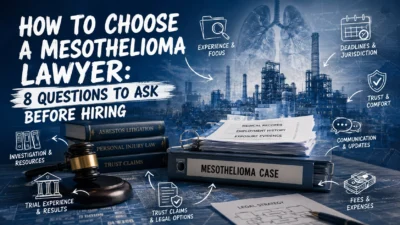
How to Choose a Mesothelioma Lawyer
The phrase “mesothelioma lawyer” appears across thousands of advertisements. The harder question is how to compare the attorneys and firms behind those advertisements.
The answer starts with relevant experience.
Ask About Specific Asbestos Litigation Experience
General personal injury experience is not necessarily the same as substantial asbestos litigation experience.
Ask how frequently the attorney or firm handles mesothelioma and asbestos cases. Find out who will actually work on the case and whether the firm has experience investigating exposure histories similar to yours.
Useful questions include:
- How many mesothelioma cases does the firm currently handle?
- Who will be responsible for day-to-day communication?
- Has the firm handled cases involving similar industries or job sites?
- How does the firm investigate exposure from decades ago?
- Does the firm handle both litigation and asbestos trust claims when appropriate?
- Which lawyers would actually appear in court if litigation requires it?
The answers can reveal more than a large advertised verdict.
Understand Who Will Actually Handle the Case
A national advertisement does not necessarily tell you which lawyer will represent you.
Some firms may work with other law firms or local counsel. Those arrangements are not inherently problematic, but clients should understand them.
Ask whether the firm you contact will remain responsible for the case, whether another firm may participate, and who will be the primary point of contact.
The engagement agreement should explain the attorney-client relationship and fee arrangement.
Ask About Resources for Exposure Investigation
A strong asbestos case can depend heavily on historical investigation.
The legal team may need to identify old employers, job sites, ships, refineries, power plants, construction projects, insulation products, equipment, contractors, or manufacturers connected to possible exposure.
Ask how the firm conducts this research and what information it will need from the client and family.
A patient should not assume that they must already know the exact asbestos product or responsible company before contacting an attorney. Investigating those questions is often an important part of the legal work.
Evaluate Communication, Not Just Case Results
Past results can provide context about a firm’s experience, but they do not guarantee future outcomes.
Communication also matters.
Mesothelioma patients may be dealing simultaneously with appointments, treatment decisions, symptoms, insurance questions, travel, and family responsibilities. A legal team should explain the process clearly and provide realistic expectations about what participation may be required.
Before hiring a firm, ask how often clients receive updates, who answers questions, and how quickly the team generally responds.
How Do Mesothelioma Lawyer Fees Work?
Many plaintiff-side asbestos attorneys represent clients under contingency fee agreements.
Under a contingency arrangement, the attorney’s fee is generally tied to money recovered for the client rather than being charged as a conventional hourly legal fee. The exact percentage and treatment of case expenses depend on the agreement and applicable law.
“Contingency fee” does not mean clients should sign without reading the contract.
Before hiring a lawyer, ask:
- What percentage will be charged as the attorney fee?
- How are litigation costs and expenses handled?
- Are expenses deducted before or after calculating the attorney fee?
- What happens to expenses if there is no recovery?
- Will another law firm share in the fee?
- Are the terms different for trust claims and lawsuits?
The answers should be clearly reflected in the written agreement.
What Information Should You Gather Before a Consultation?
A person does not need a perfect exposure history before speaking with a lawyer.
Still, basic information can make the initial evaluation more productive.
Useful records and details may include:
- pathology reports and diagnosis information;
- names of treating hospitals and physicians;
- a chronological employment history;
- military service information;
- union membership;
- names and locations of job sites;
- descriptions of work performed;
- names of coworkers who may remember the work environment;
- known asbestos products or equipment;
- places the person lived during possible exposure periods;
- information about household members who worked around asbestos.
If some information is missing, say so. Decades-old exposure histories are often incomplete at the beginning of an investigation.
What Happens After You Hire a Mesothelioma Attorney?
The exact process varies, but an asbestos case commonly begins with investigation and documentation.
The legal team may collect medical records, confirm diagnosis documentation, build a work and exposure timeline, research companies and products, interview the client or witnesses, and identify potential defendants or trusts.
If litigation is filed, the process may involve formal pleadings, document exchange, testimony, motions, settlement negotiations, and potentially trial.
Trust claims follow different administrative procedures.
Clients should ask early about the expected timeline, what participation may be required, and whether health circumstances can affect case scheduling under applicable procedural rules.
No lawyer can accurately promise that every case will follow the same path.
Mesothelioma Wrongful Death Claims Require Careful Legal Review
The original loss cannot be measured by a settlement or verdict.
A wrongful death claim is a legal mechanism for addressing certain losses recognized under applicable law. It is not a replacement for the person who died.
State laws determine who can bring the claim and which damages may be available. Depending on the jurisdiction and facts, recoverable damages may involve categories such as financial losses, certain medical or funeral expenses, loss of support, or other damages permitted by law.
Families should also be cautious about broad statements concerning settlement taxation.
Federal tax treatment depends on the nature of the claim and the components of the recovery. The IRS explains that settlement tax consequences depend on the facts and circumstances, and different components of an award may receive different tax treatment.
For that reason, statements such as “all wrongful death settlements are tax-free” are too broad.
Questions involving settlement taxation, estate consequences, or allocation of damages should be reviewed by qualified legal and tax professionals familiar with the specific settlement and jurisdiction.
Questions to Ask Before Hiring a Mesothelioma Lawyer
A consultation is an opportunity to evaluate the lawyer as much as it is an opportunity for the lawyer to evaluate the potential case.
Consider asking:
- How much of your practice involves mesothelioma and asbestos claims?
- Who will be the primary attorney handling my case?
- What jurisdictions may be relevant to my exposure history?
- How will your team investigate where and how exposure occurred?
- What types of claims might be evaluated?
- How do you handle asbestos trust claims and litigation strategy?
- What is the contingency fee percentage?
- How are case expenses handled?
- What information do you need from me and my family?
- How will the firm communicate case updates?
- What deadlines may apply to my situation?
- What can you realistically tell me about the strengths and uncertainties of the potential case?
A useful consultation should produce clearer information, not just bigger promises.
Medical Care and Legal Claims Serve Different Purposes
A legal claim does not treat mesothelioma, and a treatment plan does not resolve questions of legal responsibility.
Both may need attention at the same time.
Mesothelioma treatment depends on factors such as where the disease began, its extent, the patient’s health, and other clinical considerations. Treatment options can include surgery, chemotherapy, immunotherapy, radiation therapy, targeted therapy in selected contexts, and supportive or palliative care.
Treatment decisions should be made with qualified cancer specialists.
Legal questions should be evaluated separately by appropriately licensed attorneys. A mesothelioma lawyer can investigate exposure and potential claims, but should not replace medical advice or influence treatment decisions outside the lawyer’s professional role.
The Right Mesothelioma Lawyer Should Offer Clarity, Not Guarantees
The strongest reason to contact a mesothelioma attorney is not a promise of a headline-sized settlement.
It is the need for a careful investigation.
Mesothelioma cases can reach back decades through workplaces, military service, products, contractors, manufacturers, and corporate histories. A lawyer experienced in asbestos litigation should be able to explain how that history will be investigated, which potential claims deserve evaluation, what deadlines matter, how fees work, and what uncertainties remain.
For patients and families already managing the demands of a serious cancer diagnosis, clarity has practical value.
Compare experience. Read the fee agreement. Ask who will actually handle the case. Find out how exposure will be investigated. Be cautious of guaranteed outcomes.
The purpose of choosing a mesothelioma lawyer is not to find the biggest promise. It is to find legal representation capable of turning a complicated exposure history into a careful, evidence-based assessment of the options available.
- About the Author
- Latest Posts

Salwa Alifah Yusrina is the Editor-in-Chief at Medslat.com. She is a professional Nutritionist with over 7 years of clinical and research experience. She holds a Master’s degree in Nutrition Science from Hasanuddin University. At Medslat.com, she oversees the editorial direction and ensures that all health and nutrition content adheres to the highest standards of accuracy and evidence-based science.