
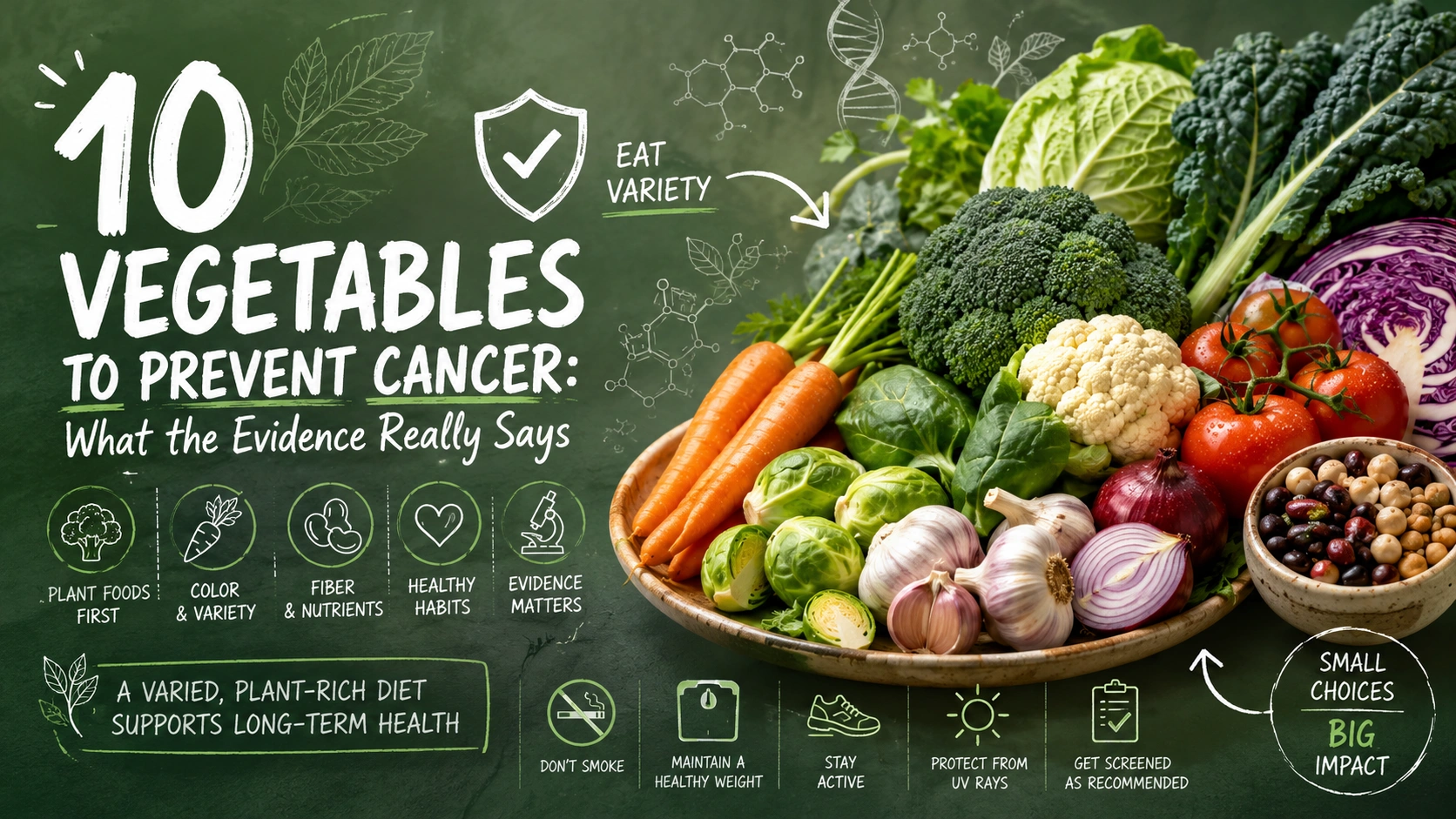
Search for vegetables to prevent cancer, and you will quickly encounter familiar names. Broccoli gets attention for sulforaphane. Tomatoes are known for lycopene. Carrots provide carotenoids, while garlic contains sulfur-containing compounds that have attracted scientific interest.
The appeal is understandable. If certain vegetables contain biologically active compounds, could eating more of them actually prevent cancer?
The evidence points to a more nuanced answer. No individual vegetable can guarantee cancer prevention. Cancer is a complex group of diseases influenced by genetics, age, tobacco exposure, alcohol, infections, ultraviolet radiation, excess body weight, environmental exposures, and other factors.
Still, the search for vegetables to prevent cancer is not misguided. Vegetables can play an important role in a cancer-preventive dietary pattern. Diets rich in vegetables and other plant foods are associated with lower risk of certain cancers, while major cancer-prevention recommendations emphasize eating a variety of vegetables, fruits, whole grains, and legumes.
The key is to think beyond a single “anti-cancer” superfood. Broccoli, leafy greens, carrots, tomatoes, garlic, onions, and other vegetables bring different combinations of fiber, vitamins, minerals, and phytochemicals to the diet. Their greatest value comes from becoming part of a diverse eating pattern maintained over time.
Can Eating Vegetables Prevent Cancer?
Eating vegetables can contribute to a dietary pattern associated with lower cancer risk, but vegetables do not provide a guarantee against developing cancer.
That distinction matters.
Scientists study diet and cancer in several ways. Laboratory experiments can reveal how a plant compound interacts with cells or biological pathways. Animal studies can help researchers investigate mechanisms in a living organism. Observational studies can identify associations between dietary habits and disease outcomes in large groups of people.
These forms of evidence answer different questions.
A compound that slows the growth of cancer cells in a laboratory dish has not necessarily been shown to prevent cancer when consumed as part of a whole vegetable. The amount used in an experiment may be far higher than normal dietary exposure, and the human body must digest, absorb, metabolize, and eliminate compounds in ways a laboratory model cannot fully reproduce.
Human nutrition research has its own complications. People do not eat nutrients in isolation. Someone who regularly eats vegetables may also consume more whole grains, exercise more often, smoke less, or maintain a healthier body weight. Researchers attempt to account for these differences, but observational research cannot remove every possible source of confounding.
Even with those limitations, the broader evidence supports making vegetables a substantial part of a healthy diet. Cancer-prevention recommendations consistently emphasize dietary patterns built around vegetables, fruits, whole grains, and legumes.
The important word is pattern.
A serving of broccoli at dinner cannot compensate for smoking. Kale juice cannot replace recommended cancer screening. Garlic cannot neutralize a consistently poor dietary pattern.
Food matters, but it is one part of a much larger cancer-prevention picture.
10 Vegetables to Prevent Cancer Risk as Part of a Healthy Diet
When people look for the best vegetables to prevent cancer, the most useful strategy is not to find one vegetable with the most impressive laboratory study. A better approach is to regularly eat vegetables from different botanical families and color groups.
Here are 10 vegetables and vegetable groups worth including in a varied, plant-rich diet.
1. Broccoli
Broccoli is probably the first vegetable many people associate with cancer prevention, and there is a biological reason for the attention.
Broccoli belongs to the cruciferous vegetable family, along with cauliflower, cabbage, kale, and Brussels sprouts. These vegetables contain glucosinolates, compounds that can be broken down into biologically active substances, including isothiocyanates and indoles.
Sulforaphane, one of the most widely discussed compounds associated with broccoli and other cruciferous vegetables, has been studied for its effects on cellular defense pathways and other biological processes relevant to cancer research.
Laboratory findings are interesting, but they require careful interpretation. Evidence from isolated compounds, cells, and experimental models does not prove that eating a serving of broccoli will prevent cancer in a person.
Human research is more nuanced. Studies of cruciferous vegetable consumption and cancer risk have produced promising associations in some areas, but findings have not been uniformly consistent across cancer types and populations.
That does not diminish broccoli’s value as a food.
Broccoli provides fiber, vitamin C, folate, carotenoids, and other compounds in a low-energy-density package. It is also easy to incorporate into ordinary meals.
Steam it until just tender, roast it until the edges begin to brown, add it to a stir-fry, or chop it into soups and pasta dishes. The best preparation method is usually the one that helps you eat it regularly.
2. Brussels Sprouts
Brussels sprouts look like miniature cabbages because they belong to the same broader plant family. Like broccoli, they contain glucosinolates and provide fiber, vitamin C, and other nutrients.
The glucosinolate story has made cruciferous vegetables an important subject in cancer research. When these compounds are broken down, they produce substances that scientists have investigated for their potential effects on processes such as carcinogen metabolism, inflammation, and cellular signaling.
Potential biological activity, however, is not the same as proven cancer prevention.
That distinction is particularly important for nutrition articles. A vegetable may contain a compound with an interesting mechanism without being a treatment or a guaranteed preventive intervention.
Brussels sprouts still deserve a place in a varied diet.
Preparation can make the difference between a vegetable people tolerate and one they genuinely want to eat. Overboiling Brussels sprouts can produce the strong sulfurous aroma many people remember from childhood. Roasting, sautéing, or briefly steaming them creates a very different result.
Try halving them before roasting, shaving them thinly into a slaw, or combining them with other vegetables in a grain bowl.
Cancer prevention is a long-term concern. Sustainable eating habits matter more than forcing yourself to eat a supposedly healthy food you dislike.
3. Cabbage
Cabbage rarely receives the same “superfood” attention as broccoli, yet it belongs to the same cruciferous vegetable family.
Green cabbage, red cabbage, napa cabbage, and savoy cabbage offer different textures and culinary uses. Their affordability also matters. A healthy dietary pattern should be realistic enough to maintain, not dependent on expensive powders, extracts, or specialty foods.
Cabbage provides fiber and vitamin C, while red varieties contain anthocyanin pigments. Like other cruciferous vegetables, cabbage also contains glucosinolates.
Its practical advantage is versatility.
Shredded cabbage can add crunch to tacos and salads. It can be quickly sautéed, incorporated into soups and stews, or fermented into foods such as sauerkraut and kimchi.
The larger lesson is simple: nutritious eating does not require exotic ingredients. Some of the most useful foods for building a plant-rich diet are inexpensive staples that have been sitting in grocery stores for generations.
4. Cauliflower
Cauliflower has become a culinary shape-shifter.
It appears roasted whole, chopped into curries, blended into soups, mashed as a side dish, and processed into small rice-like pieces. Its mild flavor makes it particularly useful for people who find stronger cruciferous vegetables difficult to enjoy.
Nutritionally, cauliflower contributes fiber, vitamin C, folate, and glucosinolate-derived compounds.
Its place on this list comes from the same broader principle that applies to broccoli and cabbage: cruciferous vegetables contain biologically active compounds of scientific interest, but no single member of the family should be treated as a cancer-prevention medicine.
Cauliflower can expand vegetable variety without requiring a dramatic change in eating habits.
Roast florets with herbs and spices, add them to curry, blend cooked cauliflower into soup, or combine it with chickpeas and other vegetables.
One caution is worth mentioning. Replacing every carbohydrate-containing food with cauliflower is unnecessary. Whole grains and legumes also have important places in plant-forward dietary patterns.
Cauliflower should expand vegetable variety rather than become a nutritional substitute for every other food group.
5. Kale and Other Dark Leafy Greens
Kale became a symbol of modern wellness culture, but its nutritional value does not depend on trends.
Dark leafy vegetables such as kale, spinach, collard greens, mustard greens, and Swiss chard provide different combinations of folate, carotenoids, fiber, vitamins, and minerals.
These nutrients participate in normal cellular processes, but that does not mean any individual nutrient acts as a shield against cancer.
Folate illustrates why nutrition science can be more complicated than a simple “more is better” equation. Folate is essential for processes including DNA synthesis and cell division, but research involving nutrients and cancer risk can depend on dose, timing, food sources, supplement use, and individual characteristics.
For most people, the practical takeaway is simpler: rotate leafy greens rather than relying on one variety.
Spinach can disappear easily into eggs, soups, pasta sauces, and bean dishes. Kale holds its texture in soups and grain bowls. Collard greens can become the foundation of a substantial side dish.
Different greens bring different textures and nutrient profiles. Variety is a strength, not an inconvenience.
6. Carrots
The orange color of many carrots comes from carotenoids, including beta-carotene.
Carotenoids are pigments found across the plant kingdom, and researchers have long studied relationships between carotenoid-rich foods, nutrient status, and disease risk.
This is also where one of nutrition science’s most important lessons becomes visible: a vegetable is not interchangeable with a high-dose supplement containing one of its components.
A carrot is a complex food. It contains fiber, water, micronutrients, and numerous compounds within a food matrix. Eating carrots is biologically different from taking a concentrated dose of an isolated nutrient.
This distinction matters because evidence supporting diets rich in plant foods should not automatically be interpreted as evidence supporting high-dose supplements.
For everyday meals, carrots are one of the easiest vegetables to use.
Eat them raw for crunch, roast them to bring out their sweetness, or add them to soups, stews, grain dishes, and vegetable trays. Yellow, purple, red, and white varieties can also broaden the range of colors and flavors on the plate.
7. Tomatoes
Tomatoes are best known in cancer research discussions for lycopene, the red carotenoid pigment also found in foods such as watermelon and pink grapefruit.
Research has examined tomato consumption, lycopene exposure, and several health outcomes, including prostate cancer risk. The evidence is more complicated than the popular claim that “tomatoes prevent prostate cancer.”
Studies can measure different things. Some examine whole tomatoes, others examine processed tomato products, dietary lycopene intake, blood lycopene concentrations, or supplements.
These exposures are related, but they are not scientifically identical.
Tomatoes still fit naturally into a plant-forward dietary pattern. They provide vitamin C, potassium, carotenoids, and other compounds while adding flavor and versatility to meals.
One interesting feature is that food preparation can change nutrient bioavailability. Cooking and processing tomatoes can alter the food matrix and influence the availability of lycopene. Eating tomatoes with some dietary fat can also affect carotenoid absorption.
That does not make raw tomatoes inferior.
Fresh tomatoes work in salads, sandwiches, and salsas. Canned tomatoes can form the base of soups, bean dishes, pasta sauces, and vegetable stews. Tomato paste adds concentrated flavor to many recipes.
The useful question is not whether raw or cooked tomatoes win. It is whether tomatoes help you build meals around a broader range of plant foods.
8. Garlic
Garlic occupies an unusual space between vegetable, seasoning, and traditional remedy.
Its strong aroma comes from sulfur-containing chemistry that has attracted considerable scientific interest. When garlic tissue is chopped or crushed, chemical reactions produce compounds that researchers have investigated in laboratory and epidemiological studies.
The existence of plausible mechanisms, however, does not establish that eating a particular amount of garlic will prevent cancer.
Research involving whole garlic, allium vegetables, extracts, isolated compounds, and supplements should not be collapsed into a single claim. A concentrated extract studied under controlled conditions is not automatically equivalent to adding garlic to dinner.
Garlic’s most immediate practical value may be culinary.
It can make vegetables, beans, lentils, whole grains, and other minimally processed foods more appealing. A healthy dietary pattern becomes sustainable when nutritious ingredients also taste good.
Use garlic to build flavor in soups, tomato sauces, sautéed greens, roasted vegetables, lentil dishes, and marinades.
Think of it as part of the pattern, not a medicinal dose.
9. Onions
Onions belong to the allium family alongside garlic, leeks, scallions, shallots, and chives.
Like garlic, onions contain sulfur-containing compounds and flavonoids that have been investigated for possible biological activity. Observational research has explored relationships between allium vegetable intake and several cancer outcomes, but findings can differ across studies and cancer types.
That uncertainty is not a reason to exclude onions. It is a reason to avoid turning incomplete evidence into a medical promise.
Onions are also a good example of how healthy dietary patterns are built from ordinary ingredients.
They form the aromatic base of countless soups, stews, bean dishes, curries, vegetable sautés, and sauces. Red onions add sharpness to salads and sandwiches, while slowly cooked onions can bring sweetness and depth to savory dishes.
A cancer-preventive diet does not have to look like a collection of special functional foods.
Often, it looks like ordinary meals built from a diverse range of plant ingredients.
10. Beans and Other Legumes
Botanically and nutritionally, beans occupy a somewhat different category from vegetables such as broccoli or carrots. Still, they belong in this discussion because cancer-prevention dietary patterns emphasize legumes alongside vegetables, fruits, and whole grains.
Beans, lentils, chickpeas, and split peas provide dietary fiber, resistant starch, plant protein, and numerous micronutrients and phytochemicals.
Fiber is particularly relevant to colorectal health.
Dietary fiber changes the physical and microbial environment of the digestive tract. Some types of fiber and resistant starch can be fermented by gut bacteria, producing metabolites including short-chain fatty acids.
Research into these pathways continues, but fiber-rich foods already have an established place in cancer-prevention dietary recommendations.
Beans are also practical replacements for some meals centered on red or processed meat.
A pot of lentil soup, black bean tacos, chickpea salad, or white bean and vegetable stew does more than add one supposedly protective ingredient. It changes the architecture of the entire meal.
That shift from individual foods to dietary patterns is where cancer-prevention nutrition becomes most useful.
Why Variety Matters More Than One “Anti-Cancer” Vegetable
Imagine two grocery baskets.
One contains a large supply of broccoli and very little else.
The other contains broccoli, carrots, spinach, cabbage, tomatoes, onions, beans, berries, oats, and whole grains.
The second basket better represents the principle behind plant-forward cancer-prevention guidance.
Vegetables differ in their fiber content, micronutrients, pigments, and phytochemicals. Cruciferous vegetables provide glucosinolates. Orange and dark green vegetables contain different carotenoids. Tomatoes provide lycopene. Allium vegetables contain characteristic sulfur compounds.
But food compounds do not operate like individual security guards stationed at the entrance to a cell. Cancer biology is far more complex, and human diets create combinations of exposures over years and decades.
A diverse plant-rich diet may influence health through multiple routes.
Fiber supports digestive health and is relevant to colorectal cancer prevention. Lower-energy-density foods can support weight management when they replace more calorie-dense options. Maintaining a healthy body weight matters because excess body weight is associated with increased risk of several cancers.
Vegetable-rich meals may also displace foods that cancer-prevention guidelines recommend limiting.
This is why the overall diet deserves more attention than the latest compound making headlines.
If you are choosing vegetables to prevent cancer risk, think in terms of variety: dark green, red, orange, cruciferous, allium, and other vegetables across the week.
The objective is not to eat every category every day. It is to avoid building an entire diet around one supposedly superior food.
Raw or Cooked: Which Is Better?
There is no universal rule that raw vegetables are better for cancer prevention.
Cooking changes vegetables in different ways. Heat can reduce levels of some heat-sensitive nutrients while softening plant cell walls and increasing the availability of other compounds.
The effect depends on the vegetable, cooking method, temperature, and duration.
Boiling vegetables in a large volume of water can cause some water-soluble nutrients to move into the cooking liquid. That matters less when the liquid becomes part of a soup or stew.
Steaming, microwaving, roasting, sautéing, and stir-frying can all be reasonable preparation methods.
Tomatoes provide a useful reminder that cooked food is not automatically nutritionally inferior. Cooking and processing can change the food matrix and influence lycopene availability.
The better question is practical: Which cooking methods help you eat a greater variety of vegetables regularly?
If raw broccoli sits untouched in the refrigerator but roasted broccoli disappears from the dinner table, roasting is the more useful method for that household.
A sustainable dietary pattern beats a theoretically perfect one that nobody follows.
How to Eat More Vegetables for Cancer Prevention
Knowing a list of vegetables to prevent cancer is less useful if those vegetables rarely make it onto the plate.
Trying to redesign an entire diet overnight often creates more friction than progress. A simpler strategy is to change the structure of meals gradually.
Start by looking at meals you already eat.
An omelet can include spinach, mushrooms, tomatoes, or peppers. A sandwich can carry leafy greens and sliced tomato. Pasta sauce can include onions, garlic, mushrooms, and greens. Chili can contain several types of beans and vegetables. A sheet-pan dinner can combine cauliflower, Brussels sprouts, carrots, and onions.
The objective is repetition with variety.
A practical approach is to keep several forms of vegetables available at the same time: something fresh for raw meals, something sturdy for roasting, frozen vegetables for convenience, and canned tomatoes or beans for quick cooking.
Frozen vegetables deserve particular attention because convenience often determines what people actually eat.
A freezer bag of broccoli or spinach that reaches the dinner plate is more valuable than aspirational produce that spoils in the refrigerator.
Canned vegetables and beans can also be practical choices. Draining and rinsing canned beans and some canned vegetables can reduce some of the added sodium.
Over the course of a week, aim for different colors and plant families rather than repeatedly chasing one supposedly superior vegetable.
A simple grocery rotation might include:
- one cruciferous vegetable, such as broccoli, cabbage, cauliflower, or Brussels sprouts;
- one dark leafy green, such as spinach, kale, or collard greens;
- one red or orange vegetable, such as tomatoes or carrots;
- one allium vegetable, such as onions, garlic, or leeks;
- one legume, such as beans, lentils, or chickpeas.
This is not a medical formula. It is simply a practical way to introduce variety into everyday meals.
What Vegetables Cannot Do
Nutrition discussions about cancer can become misleading when risk reduction is presented as complete personal control over a disease.
Vegetables cannot guarantee that someone will avoid cancer.
They cannot treat an existing tumor, replace oncology care, substitute for recommended cancer screening, or erase the effects of tobacco exposure.
A person can follow a healthy diet and still develop cancer. Another person may eat poorly and never receive a cancer diagnosis. Risk operates at the population level, while individual outcomes depend on many interacting factors.
This is also why supplement claims deserve caution.
Finding that a compound affects cancer cells in a laboratory does not prove that swallowing a concentrated supplement containing that compound will prevent cancer. Dose, absorption, metabolism, interactions, and biological context all matter.
Whole vegetables have another advantage: they contribute to the broader structure of meals.
Broccoli can replace part of a calorie-dense side dish. Beans can replace some processed meat. Leafy greens can expand the volume and variety of a meal. Onions, garlic, and tomatoes can create the flavor base for meals centered on legumes and other vegetables.
These changes affect the dietary pattern in ways that isolated supplements cannot reproduce.
Cancer prevention is therefore better understood as a collection of risk-reduction practices. These include avoiding tobacco, maintaining a healthy body weight, staying physically active, limiting alcohol, protecting skin from excessive ultraviolet radiation, receiving recommended vaccinations where appropriate, following screening recommendations, and eating a healthy dietary pattern.
Vegetables belong inside that framework, not above it.
Build the Pattern, Not the Perfect Plate
The search for vegetables to prevent cancer may begin with a list: broccoli, kale, cabbage, carrots, tomatoes, garlic, onions.
The list is useful, but the deeper answer is more important.
There is no vegetable powerful enough to guarantee cancer prevention, and research on individual foods is often more nuanced than headlines suggest. The strongest practical approach is to build a varied, plant-forward eating pattern that includes cruciferous vegetables, leafy greens, colorful vegetables, allium vegetables, beans, fruits, and whole grains.
You do not need all of them at every meal. You do not need an expensive powder, concentrated extract, or elaborate recipe.
A tomato sauce with onions and garlic counts. So does lentil soup with spinach. So does roasted broccoli beside dinner, cabbage in a taco, carrots in a stew, or frozen vegetables stirred into a quick weekday meal.
The best vegetables to prevent cancer risk are not hidden in one perfect shopping list. Their value comes from variety, consistency, and the larger dietary pattern they help create.
Cancer prevention is not found in one perfect vegetable. It is built from evidence-based habits repeated often enough to become ordinary.
- About the Author
- Latest Posts

Salwa Alifah Yusrina is the Editor-in-Chief at Medslat.com. She is a professional Nutritionist with over 7 years of clinical and research experience. She holds a Master’s degree in Nutrition Science from Hasanuddin University. At Medslat.com, she oversees the editorial direction and ensures that all health and nutrition content adheres to the highest standards of accuracy and evidence-based science.