
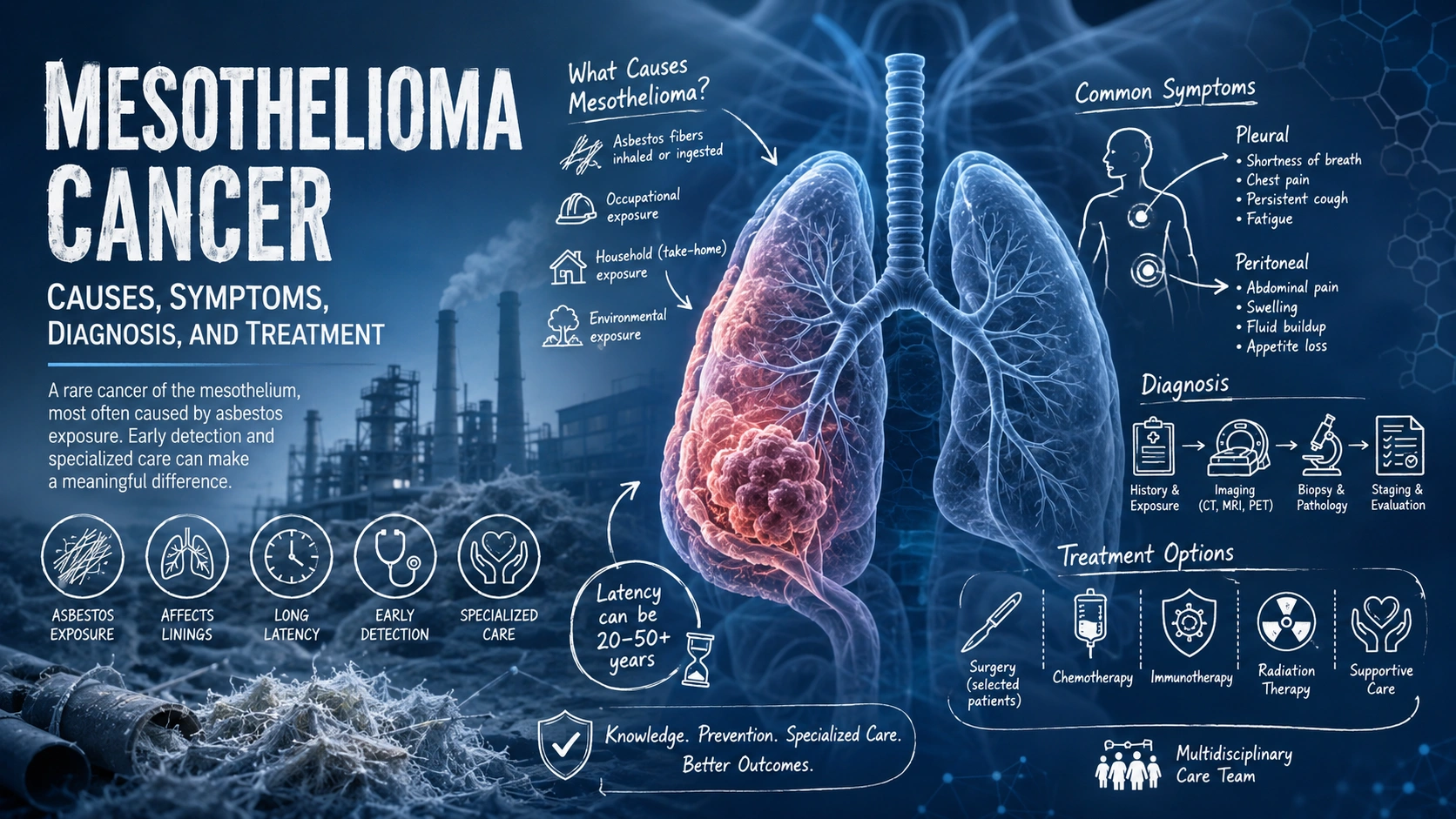
Mesothelioma is a rare cancer that develops in the mesothelium, the thin tissue lining several internal body cavities and organs. It most often affects the lining around the lungs, known as the pleura, but it can also arise in the abdominal lining and, much more rarely, in other locations.
Asbestos exposure is the major established risk factor for mesothelioma. The disease can take decades to develop after exposure, which means a diagnosis today may be related to occupational, household, or environmental contact that happened many years earlier.
Symptoms vary according to where the cancer develops. Shortness of breath and chest discomfort are common presentations of pleural disease, while abdominal pain and swelling may occur with peritoneal mesothelioma. Because these symptoms overlap with many more common conditions, diagnosis requires careful clinical evaluation and usually tissue examination.
Treatment has changed significantly over time. Depending on the type and extent of disease, care may involve surgery, systemic therapy such as chemotherapy or immunotherapy, radiation therapy, symptom-directed procedures, or participation in a clinical trial. The best approach depends on the individual case and should be planned by clinicians experienced in treating this uncommon cancer.
What Is Mesothelioma?
Mesothelioma begins in mesothelial tissue. This tissue forms a protective lining around structures within the chest and abdomen and allows organs to move against surrounding surfaces with minimal friction.
The National Cancer Institute describes mesothelioma as a cancer of the thin tissue lining the lung, chest wall, and abdomen, with asbestos exposure as its major risk factor.
Mesothelioma is different from lung cancer. Pleural mesothelioma develops in the lining around the lungs rather than in lung tissue itself. This distinction affects diagnosis, staging, and treatment.
Although the disease is rare, it is medically important because of its strong association with preventable asbestos exposure and its long latency period.
Types of Mesothelioma
Mesothelioma is classified primarily according to the anatomical site where it begins. The clinical presentation and treatment approach can differ substantially between disease sites.
Pleural Mesothelioma
Pleural mesothelioma develops in the pleura, the membrane surrounding the lungs and lining the inside of the chest cavity. It is the most common form of mesothelioma.
As the disease progresses, tumor growth and fluid accumulation around the lung can interfere with breathing and cause chest discomfort. Patients may also experience cough, fatigue, reduced appetite, or unexplained weight loss.
Treatment decisions for pleural mesothelioma depend on factors including disease extent, whether the tumor is considered resectable, histologic subtype, overall health, cardiopulmonary function, and patient preferences.
Peritoneal Mesothelioma
Peritoneal mesothelioma begins in the peritoneum, the membrane lining the abdominal cavity and covering many abdominal organs.
Possible symptoms include abdominal pain, abdominal enlargement, fluid accumulation, nausea, reduced appetite, changes in bowel habits, and unexplained weight loss.
Treatment strategies differ from those used for pleural mesothelioma. In carefully selected patients, specialized centers may consider cytoreductive surgery combined with heated intraperitoneal chemotherapy, commonly known as HIPEC.
Pericardial Mesothelioma
Pericardial mesothelioma develops in the membrane surrounding the heart. It is extremely rare, and the limited number of cases makes standardized treatment recommendations difficult.
Symptoms can overlap with other heart and chest conditions and may include chest discomfort, shortness of breath, irregular heartbeat, or effects related to fluid accumulation around the heart.
Mesothelioma of the Tunica Vaginalis
Mesothelioma can rarely develop in the tunica vaginalis, a membrane surrounding the testis.
A scrotal mass, swelling, discomfort, or fluid accumulation may lead to further investigation. Because this disease is exceptionally uncommon, diagnosis and treatment should involve clinicians with relevant specialist experience.
What Causes Mesothelioma?
The strongest established cause of mesothelioma is exposure to asbestos.
Asbestos refers to a group of naturally occurring fibrous minerals that were widely used in construction, insulation, shipbuilding, manufacturing, and other industries because of their resistance to heat and fire.
When asbestos-containing materials are disturbed, microscopic fibers may become airborne. People can inhale the fibers, which may remain in the body for many years and contribute to disease development.
The World Health Organization considers all major forms of asbestos carcinogenic to humans. Asbestos exposure is associated not only with mesothelioma but also with lung, laryngeal, and ovarian cancers and nonmalignant diseases such as asbestosis.
Not everyone exposed to asbestos develops mesothelioma. Risk is influenced by the characteristics and extent of exposure and probably by individual susceptibility. However, there is no basis for treating uncontrolled asbestos exposure as safe.
How Does Asbestos Exposure Occur?
Exposure history can be complicated because contact with asbestos may have occurred decades before symptoms appear.
Three pathways are particularly important.
1. Occupational Exposure
Historically, occupational exposure was a major source of high-intensity asbestos contact.
Workers in industries and occupations such as the following may have experienced exposure, particularly before modern restrictions and workplace controls:
- construction and demolition;
- shipbuilding and ship repair;
- asbestos mining and processing;
- insulation work;
- industrial maintenance;
- boiler and pipe work;
- power generation;
- railway maintenance;
- asbestos-cement manufacturing;
- work involving older asbestos-containing vehicle components.
Risk varies by job, historical period, country, workplace practices, and actual exposure intensity. Working in one of these industries does not automatically mean that a person experienced significant asbestos exposure.
2. Household or Take-Home Exposure
Historically, workers could carry asbestos fibers home on contaminated clothing, footwear, hair, equipment, or personal belongings.
Family members could then be exposed when handling or washing contaminated work clothes or through asbestos dust brought into the household.
This type of secondary exposure is one reason a detailed medical history may include questions about the occupations of other household members, not only the patient’s own work history.
3. Environmental Exposure
Environmental exposure can occur near asbestos mines, processing facilities, contaminated sites, or locations where naturally occurring fibrous minerals are disturbed.
Exposure can also occur when deteriorating asbestos-containing materials release fibers or when such materials are disturbed during renovation or demolition without appropriate controls.
The actual risk depends on the type and concentration of airborne fibers, duration and frequency of exposure, and other factors.
Why Can Mesothelioma Develop Decades After Exposure?
Mesothelioma has a long latency period. This means that many years may pass between asbestos exposure and the eventual development or diagnosis of cancer.
A person may therefore have difficulty remembering an exposure that occurred during an earlier job, military service, industrial work, building renovation, or household contact many years before symptoms began.
The long latency period also explains why countries that restricted asbestos use can continue to record new mesothelioma cases. Current disease patterns often reflect exposures that happened decades earlier.
For patients undergoing evaluation, a detailed occupational and environmental history can therefore be clinically relevant even when the suspected exposure occurred in the distant past.
What Are the Symptoms of Mesothelioma?
Mesothelioma symptoms depend on the anatomical site and extent of the disease.
Symptoms can be nonspecific, meaning that they also occur in many other medical conditions. Experiencing one or more symptoms does not establish a diagnosis of mesothelioma.
Symptoms of Pleural Mesothelioma
Possible symptoms include:
- shortness of breath;
- persistent cough;
- pain or discomfort in the chest or under the rib cage;
- fatigue;
- reduced appetite;
- unexplained weight loss;
- symptoms associated with fluid accumulation around the lung.
Symptoms of Peritoneal Mesothelioma
Possible symptoms include:
- abdominal pain;
- abdominal swelling;
- abdominal fluid accumulation;
- constipation or other changes in bowel habits;
- reduced appetite;
- unexplained weight loss;
- fatigue.
Persistent or unexplained symptoms deserve medical evaluation, especially when a person has a known or possible history of asbestos exposure.
Symptoms alone cannot distinguish mesothelioma from more common respiratory, cardiovascular, gastrointestinal, or other medical conditions.
How Is Mesothelioma Diagnosed?
Diagnosing mesothelioma can be challenging because the disease is rare and its symptoms and imaging findings can resemble those of other conditions.
The diagnostic process may involve several stages.
Medical and Exposure History
Evaluation typically begins with a medical history, physical examination, and discussion of symptoms.
A clinician may ask about previous occupations, industries, military service, construction or renovation work, household exposure, and environmental contact with asbestos.
Because exposure may have occurred decades earlier, seemingly distant employment and residential history can be relevant.
Imaging Tests
Imaging helps clinicians identify abnormalities and determine what additional evaluation may be necessary.
Tests may include:
- chest X-ray;
- computed tomography, or CT;
- magnetic resonance imaging, or MRI, in selected situations;
- positron emission tomography, or PET, for selected staging and treatment-planning purposes.
Imaging can identify suspicious abnormalities, but imaging alone generally cannot provide definitive histologic confirmation of mesothelioma.
Biopsy and Pathology
A biopsy obtains tissue that can be examined by a pathologist.
Pathologic examination is central to establishing the diagnosis and distinguishing mesothelioma from other cancers that can have similar appearances.
The method used to obtain tissue depends on the location of the suspected disease, the patient’s condition, and the clinical situation.
Adequate tissue sampling is also important because mesothelioma can have different histologic patterns. For pleural disease, these include epithelioid, sarcomatoid, and biphasic patterns.
Histology can influence prognosis and treatment planning, but it is only one part of the overall clinical assessment.
Mesothelioma Staging and Treatment Planning
Staging describes the extent of cancer and helps clinicians evaluate treatment options.
For pleural mesothelioma, assessment may consider the extent of the primary tumor, regional lymph node involvement, and distant metastatic spread.
Treatment planning requires more than assigning a stage. A multidisciplinary team may also consider:
- anatomical site of the disease;
- histologic subtype;
- tumor distribution;
- resectability;
- lung and heart function;
- general health;
- other medical conditions;
- previous treatments;
- symptoms and quality of life;
- patient goals and preferences.
Because mesothelioma is rare and treatment decisions can be complex, consultation with a center or multidisciplinary team experienced in mesothelioma may be valuable.
Mesothelioma Treatment Options
There is no single treatment plan appropriate for every person with mesothelioma.
Treatment varies substantially between pleural and peritoneal disease and between patients with localized, potentially resectable tumors and those with unresectable or metastatic disease.
Current treatment strategies may involve surgery, chemotherapy, immunotherapy, radiation therapy, local procedures, supportive care, or clinical trials.
1. Surgery
Surgery may be considered for selected patients, particularly when disease characteristics and overall health make a surgical strategy appropriate.
The role of surgery in pleural mesothelioma is complex and has evolved as evidence has developed. Patient selection and multidisciplinary evaluation are essential.
Pleurectomy/Decortication
Pleurectomy/decortication, often abbreviated P/D, is a lung-sparing surgical approach that removes affected pleural tissue and attempts to remove visible tumor while preserving the lung.
The exact extent of surgery can vary.
Potential benefits and risks depend on disease distribution, surgical technique, patient selection, and the experience of the treatment center.
Extrapleural Pneumonectomy
Extrapleural pneumonectomy, or EPP, is a more extensive operation that includes removal of the affected lung along with involved pleural tissue and other adjacent structures according to the surgical plan.
Because it is a major operation with substantial risks, it is not appropriate for many patients. Its role must be considered carefully by experienced multidisciplinary teams.
Cytoreductive Surgery and HIPEC
For selected patients with peritoneal mesothelioma, specialized centers may consider cytoreductive surgery combined with hyperthermic intraperitoneal chemotherapy, known as HIPEC.
Cytoreductive surgery aims to remove visible tumor within the abdomen. Heated chemotherapy is then circulated within the abdominal cavity to treat microscopic residual disease.
This approach is not suitable for every patient and requires evaluation at an experienced center.
Surgery for Rare Mesothelioma Sites
Surgical management of very rare forms, including mesothelioma of the tunica vaginalis, is based on individual disease characteristics and specialist assessment.
Because these cancers are uncommon, evidence is much more limited than for pleural mesothelioma.
2. Chemotherapy
Chemotherapy remains an important component of mesothelioma treatment.
Pemetrexed combined with a platinum drug such as cisplatin or carboplatin has an established role in systemic treatment. However, treatment selection has evolved with the introduction of immunotherapy and newer combination strategies.
Chemotherapy may be used in different clinical settings depending on disease site, stage, treatment goals, and the overall treatment plan.
Possible adverse effects depend on the drugs used and the individual patient. They may include:
- fatigue;
- nausea or vomiting;
- reduced blood cell counts;
- anemia;
- increased infection risk;
- appetite changes;
- kidney or nerve effects associated with particular drugs.
Supportive medications, laboratory monitoring, and treatment adjustments can help manage many adverse effects.
Patients should discuss the expected benefits, risks, monitoring requirements, and alternatives of a proposed chemotherapy regimen with their oncology team.
3. Immunotherapy
Immunotherapy has changed the systemic treatment landscape for pleural mesothelioma.
Immune checkpoint inhibitors work by targeting regulatory pathways that cancer can use to suppress immune responses.
Nivolumab combined with ipilimumab is an established first-line option for certain patients with unresectable pleural mesothelioma.
Another important development occurred in September 2024, when the U.S. Food and Drug Administration approved pembrolizumab in combination with pemetrexed and platinum chemotherapy as first-line treatment for unresectable advanced or metastatic pleural mesothelioma.
These treatments are not interchangeable or appropriate for every patient. Selection depends on the disease setting, medical history, potential contraindications, treatment availability, expected benefits, and risks.
Immune checkpoint inhibitors can cause immune-related adverse events because activated immune responses may affect healthy organs. Potentially affected systems include the lungs, liver, intestines, thyroid and other endocrine organs, skin, kidneys, and additional tissues.
Patients receiving immunotherapy need appropriate monitoring and should promptly report new or worsening symptoms to their treatment team.
4. Radiation Therapy
Radiation therapy uses high-energy radiation to damage cancer cells within a defined treatment area.
Its role varies according to disease site, previous treatment, tumor location, symptoms, and the overall treatment strategy.
Radiation therapy may be used to:
- relieve pain or other symptoms caused by local tumor growth;
- treat selected areas of disease;
- contribute to multimodality treatment in carefully selected clinical settings.
Modern techniques can improve dose targeting, but surrounding organs remain an important consideration, particularly when treating tumors within the chest.
Possible adverse effects vary according to the treatment field and dose. They may include fatigue, skin reactions, irritation of nearby structures, or inflammation affecting organs within the radiation field.
A radiation oncologist evaluates the expected benefits and risks for the individual patient.
5. Symptom-Directed and Supportive Care
Supportive care is an important part of mesothelioma treatment at every stage.
Mesothelioma can cause breathlessness, pain, fatigue, reduced appetite, anxiety, sleep problems, and other symptoms that affect daily life.
Care may include:
- procedures to manage recurrent fluid accumulation;
- pain management;
- treatment of breathlessness;
- nutrition support when needed;
- rehabilitation;
- psychological support;
- palliative care.
Palliative care does not mean that cancer-directed treatment must stop. It can be provided alongside oncology treatment to help manage symptoms, support communication, and improve quality of life.
What About Experimental Treatments?
Mesothelioma research continues to evaluate new systemic therapies, treatment combinations, biomarkers, and other approaches.
The original version of this article described several experimental strategies as though they were established options. That can be misleading because an intervention studied in an early clinical trial is not necessarily safe, effective, or approved for routine treatment.
Research areas may include:
- new immunotherapy combinations;
- targeted approaches for selected molecular characteristics;
- novel drug combinations;
- biomarker-guided treatment;
- cellular and immune-based strategies;
- improved combinations of systemic and local therapies.
The evidence supporting these approaches varies. Patients interested in experimental treatment should discuss appropriate clinical trials with their oncology team rather than assuming that every investigational therapy is suitable for their condition.
Clinical Trials for Mesothelioma
Clinical trials are an important part of progress in mesothelioma care because the disease is rare and treatment continues to evolve.
Different trials may investigate:
Treatment Trials
These studies evaluate new treatments, combinations, treatment sequences, or methods of delivering therapy.
Diagnostic and Biomarker Studies
These studies investigate tools that may improve diagnosis, disease classification, treatment selection, or monitoring.
Supportive Care Studies
These studies focus on symptoms, treatment adverse effects, function, communication, or quality of life.
Clinical trial participation is voluntary. Eligibility depends on the study protocol and may involve factors such as disease type, previous treatment, stage, laboratory results, organ function, age, and general health.
Potential benefits and risks vary between trials. An investigational treatment may provide benefit, have no additional benefit, or cause unexpected adverse effects.
Before joining a trial, participants should receive information about the study purpose, procedures, potential risks, potential benefits, alternatives, and their rights through the informed consent process.
Patients can ask their oncology team about appropriate studies and use recognized clinical trial registries to identify research opportunities.
Can Mesothelioma Be Prevented?
Preventing asbestos exposure is the most important strategy for reducing future asbestos-related disease.
The World Health Organization states that the most efficient way to eliminate asbestos-related diseases is to stop the use of all forms of asbestos.
Prevention strategies include:
- identifying asbestos-containing materials before renovation or demolition;
- following occupational exposure regulations;
- using trained and appropriately qualified professionals for asbestos assessment and removal;
- preventing contaminated work clothing and equipment from entering homes;
- avoiding unnecessary disturbance of suspected asbestos-containing materials;
- using appropriate exposure controls in workplaces where asbestos hazards exist.
Suspected asbestos-containing material should not be drilled, sanded, cut, broken, or removed without appropriate assessment and controls because disturbance can release fibers into the air.
What Is the Outlook for People With Mesothelioma?
Mesothelioma prognosis varies considerably between individuals.
Factors that can influence treatment options and outlook include:
- anatomical site;
- stage and extent of disease;
- histologic subtype;
- tumor characteristics;
- whether local treatment is feasible;
- age;
- general health;
- heart and lung function;
- activity and functional status;
- response to treatment.
Population statistics cannot predict exactly what will happen to an individual patient.
Treatment for pleural mesothelioma has changed in recent years, particularly with the development of newer systemic therapy options. Research continues to evaluate how best to select and sequence treatments for different patient groups.
Patients should discuss prognosis with clinicians familiar with their complete medical information rather than relying on general survival statistics alone.
When Should You Seek Medical Advice?
Having been exposed to asbestos does not mean that a person will develop mesothelioma.
However, a possible history of asbestos exposure can be important medical information, especially when persistent respiratory or abdominal symptoms develop.
Consider discussing your history with a healthcare professional if you:
- worked directly with asbestos or asbestos-containing materials;
- worked in an industry with potential historical exposure;
- lived with someone who regularly worked around asbestos;
- experienced significant environmental exposure;
- have persistent unexplained chest, breathing, or abdominal symptoms.
There is no single symptom that confirms mesothelioma, and many symptoms associated with the disease have much more common causes.
A healthcare professional can assess symptoms, medical history, and exposure history and determine whether further evaluation is appropriate.
Living With Mesothelioma
A mesothelioma diagnosis can affect physical health, emotional well-being, family relationships, work, and finances.
Patients may benefit from a broader support team that can include:
- medical and radiation oncologists;
- surgeons;
- pulmonologists or other relevant specialists;
- oncology nurses;
- palliative care clinicians;
- social workers;
- rehabilitation professionals;
- mental health professionals;
- nutrition professionals when clinically indicated.
Some patients also find support groups helpful, while others prefer individual counseling, family support, spiritual care, or private forms of support.
The appropriate approach depends on individual needs and preferences.
The Bottom Line
Mesothelioma is a rare cancer strongly associated with asbestos exposure. Because the disease can develop decades after exposure, a careful occupational, household, and environmental history can be an important part of medical evaluation.
Symptoms vary according to the location of the disease and can resemble those of more common conditions. Diagnosis generally requires imaging and appropriate tissue evaluation rather than symptoms alone.
Treatment has evolved and may include surgery for selected patients, chemotherapy, immunotherapy, radiation therapy, symptom-directed procedures, supportive care, and clinical trials. The best strategy depends on the type and extent of disease, histology, overall health, treatment goals, and other individual factors.
Anyone concerned about possible asbestos exposure or persistent unexplained symptoms should discuss those concerns with a qualified healthcare professional. For people diagnosed with mesothelioma, evaluation by a multidisciplinary team experienced in this rare cancer can help clarify available treatment options.
Writer: Salwa Alifah Yusrina
- About the Author
- Latest Posts

Salwa Alifah Yusrina is the Editor-in-Chief at Medslat.com. She is a professional Nutritionist with over 7 years of clinical and research experience. She holds a Master’s degree in Nutrition Science from Hasanuddin University. At Medslat.com, she oversees the editorial direction and ensures that all health and nutrition content adheres to the highest standards of accuracy and evidence-based science.